 This website uses cookies.
  Goonhammer Reviews: Archmagos, by Guy Haley
As someone who not only plays Admech, but considers Genefather one of my favorite 40k novels, this third entry in Haley's Cawl series had much to account for. I should say only that it delivers, and does so with enthusiasm only the mad genius of the Imperium can.
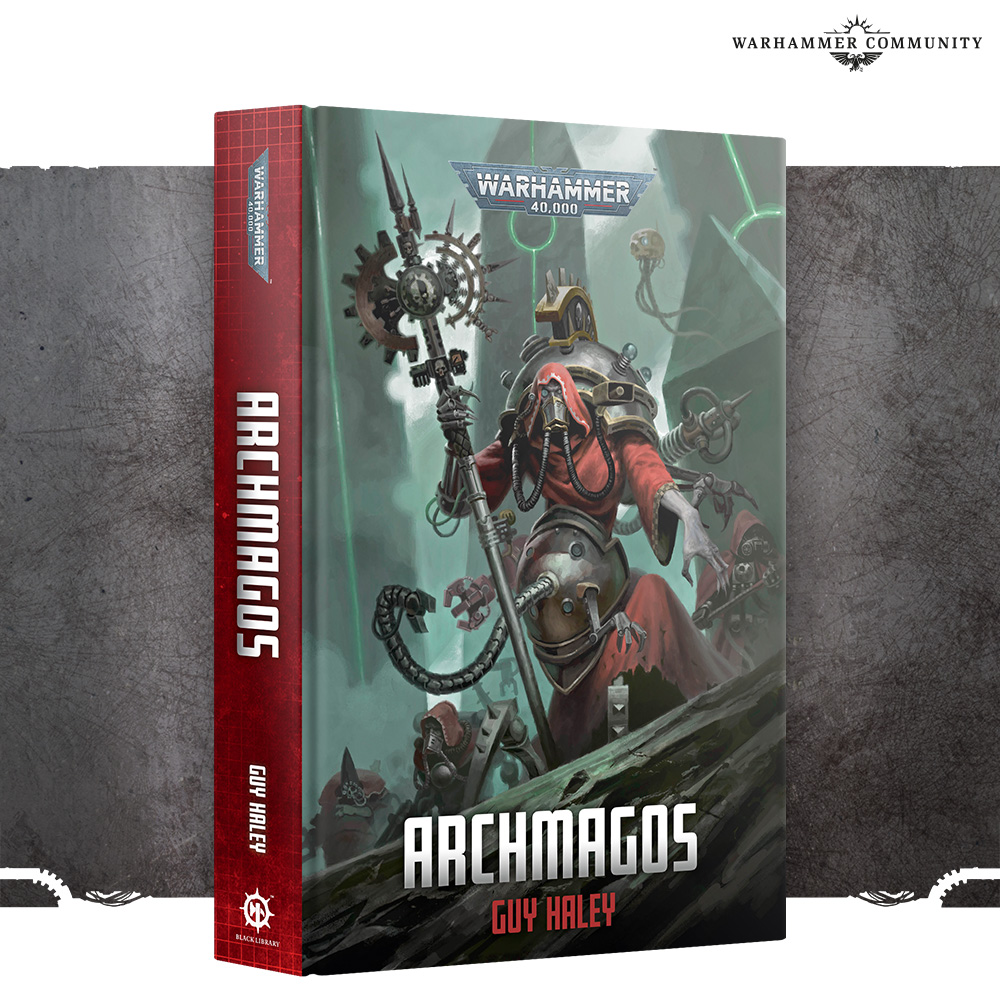 Image credit: Games Workshop
The Fellowship of the Gear
We've had quite a bit of time with Haley's Cawl, from his drudgery concerning the cleanup on Sotha to events like his trial at the Conclave Chronalis, where he pulled an Ace Attorney and weaseled his way out of an accusation of innovation. You can with immediate clarity see that Cawl is a joy to write, and with his capacity for adages we use today gives us unparalleled insight into the machinations of his many minds. Cawl is disarming in this sense, often erring closer to an irreverent Holmes monologue than the priestly deference of most Mechanicus acolytes, echoing the humanity we see growing in his primary companion of the book, Solana. Solana, to complete the comparison, is Watsonian in her ability to make Cawl's ingenuity seem all the more spectacular, not out of stupidity, but through her eager curiosity. She is placed at odds with Cawl at the novel's outset, a token of the larger Imperium's frustration with his lack of response, but the Archmagos' practicality rubs off on her by the adventure's end. Their dynamic is absolutely fantastic, and she serves as a far better sounding board than the previous contender, Friedisch Qvo.Solana's steel-tipped fingers scratched over parchment.
'Do you mean you will be reconstituted, like your friend here?'
'I am his friend', agreed Qvo-89.
'Omnissiah alive, no!' said Cawl. 'Because that would be dangerously close to creating an abominable intelligence, so detailed and wide-ranging the records of my engrams are, and we all know I would never do anything like that.' He tipped her a wink over his mandibular shield, then he went back to his work and his humming.
Archmagos, page 120
That's the final secondary character with any real issues in my eyes, as the last one of import is handled wonderfully. Returning from Genefather (as the primary reason this is a sequel to it) is the temporarily-embarassed Cryptek/GLaDOS potato battery analogue, AsanethAyu, forced to assist in the adventure. I am not kidding with that descriptor even slightly, as Cawl brings with him into the tomb the talking severed head of a Nihilakh engineer; AsanethAyu is an utter treat, full of the pomp and toothless malice of an immortal being brought so low. At every turn, she attempts to get Cawl & co killed in any way that might see her bequeathed a new body, to such an extent Qvo actively acknowledges the comedy of the situation later on. Her predicament is contrasted by that of a more complete Necron in the story, who also tags along for a time, but each are played more for comedy and plot convenience than real menace.
'Is that your name for our cursed? Flayed Ones.' Tsu Tsek weighed the words. 'That is an adequate description. Yes. Flayed Ones.'
'Then there is no time to waste...' Cawl frowned. "Well, that's not strictly true, we could waste all the time in the world, but we'd not fulfil our goal of saving the species, and what kind of...' Cawl's mouth clacked shut. He looked around at his companions' disbelieving stares. 'I'm babbling, aren't I? Let's get on with it.'
Archmagos, page 163
 Image credit: Games Workshop
On Vashtorr
The cogs of long-dead beasts jutted from the ground, and here and there were tumbled ruins hinting at humbler days, before voidships and lasweaponry, before plasma reactors, before steam. Forges where bronze swords were once cast. Ancient workshops, their roofs collapsed, were still cluttered with chariot wheels. Further out were quarries carpeted with discarded flints.
Vashtorr was eternal. Vashtorr always was. The moment the first sentient being crafted a tool, Vashtorr had been there.
Archmagos, page 230
'Vashtorr sells or Vashtorr commands, Vashtorr rarely cooperates. Unless, unless...' The daemon lifted his hand, as if weighing the worth of Kraverek's words, or that of his soul. 'Unless the offer intrigues, unless the offer rewards.'
Archmagos, page 295
In the end however, all that Vashtorr has done, from organizing a march of Soul Grinders (including one of the very first), to bargaining with Warpsmiths, is in pursuit of a single goal: Belisarius Cawl. His endgame is the Archmagos, imprisoned at the Forge of Souls, and the import a god gives to Cawl only heightens his role as one of the main players in the Imperium in current canon.
Minor Quibbles
I do take some umbrage with one aspect of the novel in particular, and that comes in the form of its lead-up, and odd position among the other Haley Cawl novels. First and foremost, it is difficult for me to care about the Marine attaches in Cawl's circle, even less so of the Space Wolves who cannot go a novel without mentioning Mjød. Part of the benefit of Genefather was that, in being more evenly split between Cawl & Bile, much of the bolterporn between faded into the background or otherwise played second fiddle to the scientific phallus-appraisal contest between our two leads. Here, while Cawl is given more than half of the book to reign over the narrative, Vashtorr's focus is split between his emissaries, Iron Warriors, and his Soul Grinders' conflict with Marines. Less is more for the Arkifane himself, that I will admit, but the gapfill here is worse than in prior Haley adventures.The second qualm I have is with regards to the relative necessity of both Belisarius Cawl: The Great Work & Genefather—that is to say, you absolutely must have read The Great Work, and Genefather is a just nice-to-have in your mental library. This novel isn't the end of a trilogy, and feels far closer to the second entry in one forthcoming (with the third being a more explicit confrontation between Cawl & Vashtorr). Genefather, which I would contend is the far stronger Cawl novel, slots in as a weird 'interquel' here, the Lion King 1 1/2 of this body of work. Much of this problem stems from personal bias, but it does genuinely make these books harder to recommend to people without added context, which could hurt its longevity as a series.
What I don't have problems with, unlike a few people to which I've spoken, is how thoroughly the Necrons get bodied in this story. Their technology is made banal to Cawl, a statement which seems hyperbolic but structurally is a truth of the novel. The fact that it is structural, however, reveals why I see this as a strength: Cawl's understanding, not entirely made common knowledge to the reader, helps aid his position as the 'senior detective' to Solana's wide-eyed historian. The fact Cawl can make mincemeat of Overlords or understand temporal imprisonment is less the point than the fact that we as readers are not made entirely privy to the how or why. The only real difference is that Holmes had a denouement, where the machinations of the Archmagos' mind are left more to wonder about, just as both Vashtorr & Solana do. This is 40k: If your army is on the cover, they're going to seem impossibly strong in the text, get with the program.
Final Thoughts
'I know when I say, "I'm Belisarius Cawl and I can do anything," it makes me look a little egotistical.' He held up hands to silence words that were not said. 'I know, I know, I shouldn't be too hard on myself, and in a matter of fact, I'm not, because that was pretty spectacular, no?'
Archmagos, page 278
This is a novel with an absolutely stellar core premise—Cawl & co in a Necron dungeoncrawl—mildly burdened by everything else going on. I do not fault it for that, and it is only comparatively that the non-World Engine plot falters in the face of most 40k fiction at large. This seems to me an ideal recommendation to people who are getting into the universe through games like Mechanicus I & II, the latter coming out soon™, given they share the same narrative thrust. For those seasoned Black Library readers, this is a fairly light novel comparatively, but I cannot stress how fun Cawl is compared to nearly every other protagonist not named Ciaphas Cain. And for the general readership, especially those with experience in games like Dungeons & Dragons: Welcome home, and do try to skim The Great Work on your way in.
Have any questions or feedback? Drop us a note in the comments below or email us at contact@goonhammer.com. Want articles like this linked in your inbox every Monday morning? Sign up for our newsletter. And don’t forget that you can support us on Patreon for backer rewards like early video content, Administratum access, an ad-free experience on our website and more.