 This website uses cookies.
  Goonhammer Reviews: The Great Work & Genefather, by Guy Haley
This is going to be a bit less in-depth than my look at Archmagos, given we're reviewing two books today, but it's vital I make one thing clear: These are some of my favorite books set in the Warhammer universe, and certainly my favorites not set at the time of the Heresy. Haley manages to succeed at the one thing he truly needed to—making Cawl himself compelling, eloquent, and suitably unhinged.
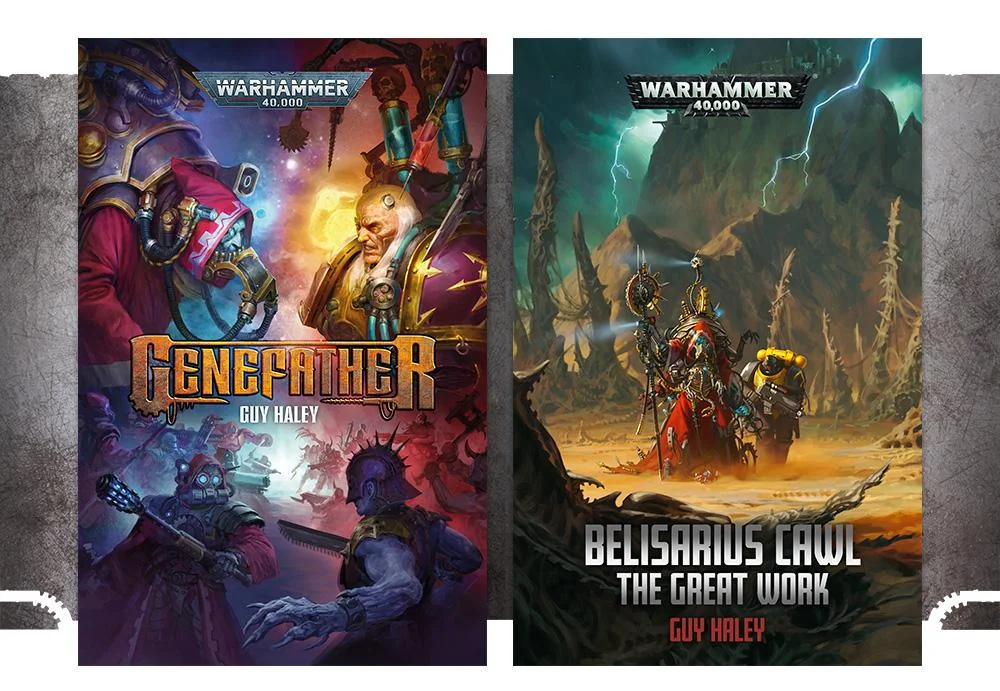 Image Credit: Games Workshop.
The Great Work
To understand from where The Great Work stems, Haley's previous work with the Dark Imperium series is an important factor. He's an author familiar with the trappings of writing Marines, with their militaristic pomp and tactical expertise, and a number of Astartes characters created for Dark Imperium appear here; that said, I'd not say those books are required background, as I had no trouble going in blind during my first read back when the book came out. I mention this instead because Haley's take on Cawl is so juxtaposed from his bodyguards and attaches that it leads to some of the best character work in current canon. If you're used to how Marines are normally written, so-called 'bolter porn', any time Cawl speaks ought to be a breath of fresh air.Cawl turned around like a serpent coiling. ‘Oh, Decimus,’ said Cawl admonishingly. ‘Let’s be civil. I realise that you bear me some ill will. The taking away of childhood. The sleep of methalon hyper-freeze, the pain of the procedures of apotheosis and, I admit,’ said Cawl, raising several limbs and his voice to forestall Felix’s objections, ‘that I was a very poor substitute father, although I did try my best. All of you are my children.’
Belisarius Cawl: The Great Work, page 59
They were in the warp. There were no xenos monsters. No Space Marines fighting. No burning ambition.
‘Silence on the Silencia.’
Cawl looked up from the cylinder with a scowl. ‘Are you making a joke, Friedisch?’
Friedisch gave a little grin. ‘I am!’
Cawl turned back to his work with a shake of his head.
Friedisch gripped his friend’s shoulder amicably. ‘You always have to be the best at everything, Belisarius. The most intelligent, the most gifted, the quickest witted.’
‘That is because I usually am.’
Belisarius Cawl: The Great Work, page 123
‘My lord,’ Diamedes voxed. ‘Company. Cawl’s creature.’
Alpha Primus emerged from Cawl’s transport and strode towards the others. The uncoloured ceramite of his plain armour was as grey as the landscape. His helm, though perfectly maintained, somehow conveyed the ugliness of his butchered face.
‘Stand aside,’ he said. ‘The archmagos has commanded that I deal with this obstruction.’
‘On your own?’ said Tullio in disbelief. ‘Let us help you dig, brother.’
‘I have no brothers,’ said Alpha Primus.
Belisarius Cawl: The Great Work, page 77
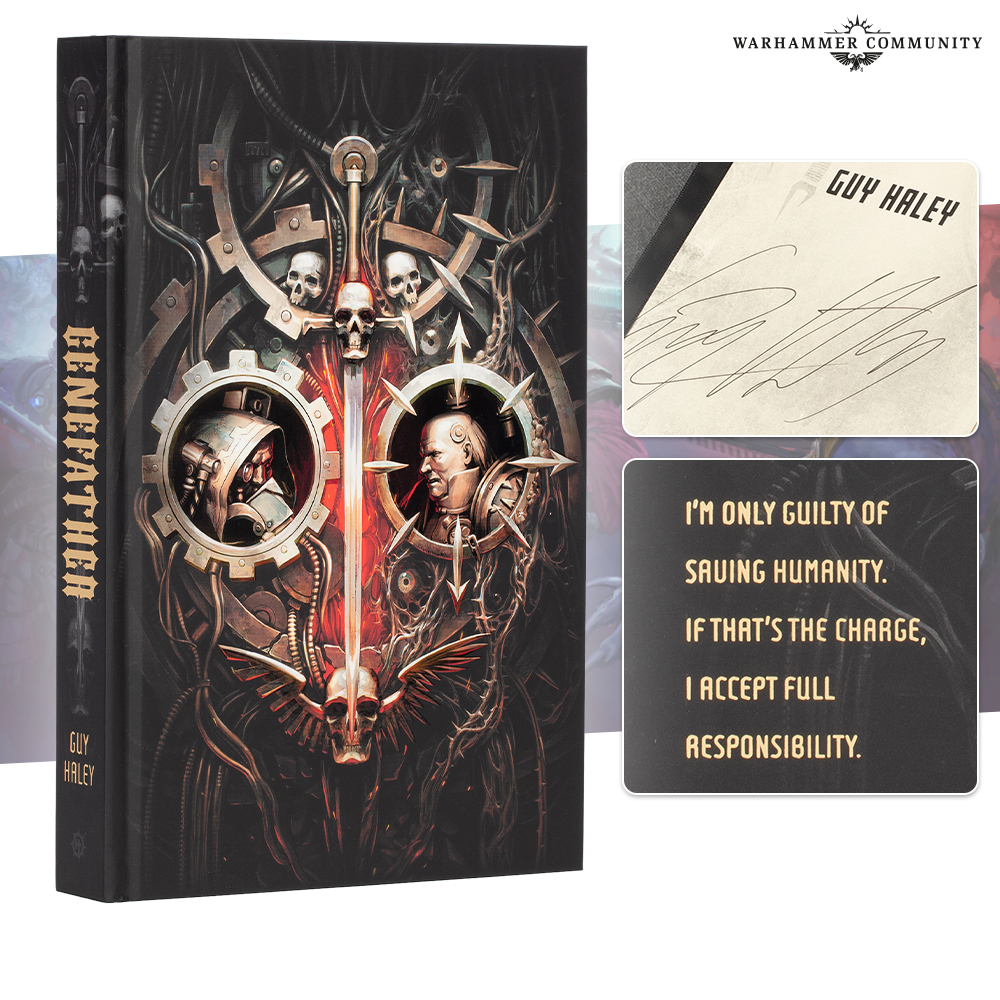 Image Credit: Games Workshop.
Genefather
Knights, Mutants, Cawl, Bile. A trial straight out of Ace Attorney. Genefather is a full-feeling book, bursting at the seams for what it attempts to fit in, yet somehow succeeding in feeling complete. Given I have little but praise for the novel, as it's one of my favorites in the entire Black Library catalog, I think it's important to speak on my issues with the book first: Not only is Alpha Primus worse here than he is in The Great Work, Genefather's place in the overall canon/Cawl series order has been nebulous. This is due in part to the fact that it's split between the perspectives of both Cawl & Bile, and the latter's literary history was quite a bit denser at the time of the novel's penning. Indeed, Bile comes out ahead in Genefather, and it feels more to be his triumph, and merely Cawl's stepping stone along the path we'd see for him in Archmagos. Quibbles about canon and focus aside, boy is this book good.‘Do you have a point to make?’ said Frenk. ‘Surely you simply activated the STC.’
‘On this occasion, no, I did not,’ said Cawl. ‘I wished to test my theorem. Using my developing understanding of the methods of the ancients, I set out to experiment, and recreate the device within the STC. It took fifteen years, but once I had a working prototype, I opened that STC. Do you know what I found?’
‘Enlighten us,’ said Frenk. It sounded like he was gritting his teeth behind his respirator, if he had teeth.
‘My device was almost exactly the same as theirs. So I did it again, and again, and again, until I matched the precise designs of seven STCs I had uncovered, not opening them until I had pursued the same results using the same techniques. Therefore, I put it to you that I am no innovator. The use of the techniques of the ancestors to rediscover the knowledge of the ancestors cannot possibly be regarded as a crime.’
Genefather, pages 176-177
‘He is not designed! Not completely. Do you not see? I made him from myself. In his genecode, I live on. I nurtured him. I…’ He paused, unsure whether he could voice the words. ‘I love him. He is my son.’
‘Then I am sorry that I must do this,’ said Bile, and pushed his hand deep into Primus’ chest cavity. Cawl tensed, trapped. For the first time in a long time, he felt defeated. Bile’s face twisted in concentration.
Genefather, page 300
Where this book succeeds though, is in fleshing out Cawl's relationships. We will not see my favorite of the Archmagos' merry band until, appropriately, Archmagos, but here Qvo is both at his funniest and his most prudent as a point made about Cawl. Genefather gets to the heart of why Cawl is ultimately on a path to save the Imperium, despite some very explicit heresy, a portion of which is indefensible: His humanity is allowed to pierce the veil of Imperial thought. He thinks freely, loves dearly, and mourns messily, just as we all do. Qvo's emblematic of that last bit especially, as Cawl is forced to recount his reconstruction. While some simulacra of Friedisch could be retained, that pain causes Cawl to make some dubious sacrifices in the end, and it exemplifies why he's my favorite Warhammer character in this novel in the same breath that Bile falls a bit flat...if you've read his Trilogy, that is. I would bet Genefather has the chance to be anyone's favorite Black Library book, in a relative vacuum, and it being mildly burdened by context before it, on top of its context in Haley's Cawl series, are just unfortunate hangers-on.
Final Thoughts
‘These people who fall for the lies of the Dark Gods, they do it from despair. They fall into the trap of thinking that the gentler human emotions are worthless, that they leave us with vulnerabilities that can be exploited. All they have room for is hate and fear and horror. They neglect affection. They chase individual strength and forget that human beings only succeed together. No man is an island, a great thinker once said. A man is remembered for his deeds, but he is remembered by his companions. In short, we all need friends, and so I need you.’
Genefather, page 310
Haley clearly enjoys writing Cawl, and you can tell that he's found a voice for the man in Genefather, far more eager to converse than monologue. That being said, at no point in either of these books was I as a reader uninterested in what our lead had to say—he is eminently intriguing, often funny, and never boring. A lot of the magic of Cawl is in the fact that he's not a warrior, he's a scientist (and later, an investigator), standing in contrast to a bevy of Black Library books that emphasize the War in Warhammer. If you want to read stories of a man—just a man—in the 41st millennium who thinks, feels, and jokes, this series is for you. I can only hope that Haley comes back for a fourth installment.
Have any questions or feedback? Drop us a note in the comments below or email us at contact@goonhammer.com. Want articles like this linked in your inbox every Monday morning? Sign up for our newsletter. And don’t forget that you can support us on Patreon for backer rewards like early video content, Administratum access, an ad-free experience on our website and more.