 This website uses cookies.
  Goonhammer Roundtable: The New ITC Rules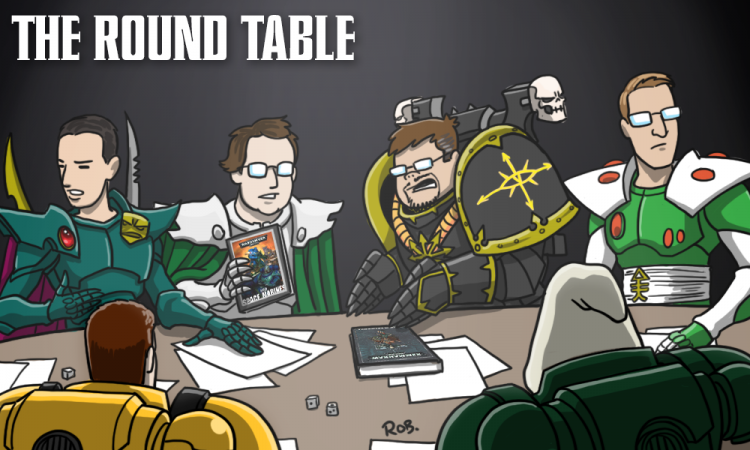
In case you missed it, you can find a link to the new ITC rules here: https://www.frontlinegaming.org/2020/02/14/40k-itc-champions-missions-are-updated/
The Overall Changes
Five major areas of changes:
- Pre-game
- All missions now use “full army” deployment, and have adopted the “Attacker/Defender” terminology from the CA19 missions.
- The Defender gets to re-roll the deployment map once if they choose. This is really neat, as it adds a bit of extra upside to not getting to go first.
- No seize.
- Objective Maps:
- Nexus Control now has placed objectives, with two going in no-man’s land and one in each deployment zone.
- Precious Cargo now has a centre objective.
- Attacker/Defender also used to give clarity on the order all of this happens, which was great as there was ambiguity in the old pack.
- Bonus points:
- Generally easier. Crucible and What’s Yours is Mine unchanged, which makes sense as they were the easiest of the old set.
- Seize Ground is now four rather than five.
- Cut to the Heart is now holding your home objective and the centre. This is much easier and makes scoring the bonus often pretty easy for lots of armies.
- Nexus Control now only requires you to hold the two objectives in no-man’s land.
- Precious Cargo has an alternative option to hold three objectives.
- Secondaries change a lot:
- Now have an explicit “Seek and Destroy” and “Maneuver” set. You have to pick at least one from each. Old School sits in neither.
- Stacking rules are now that a single unit can never achieve two
- New Secondaries:
- Born for Greatness (Seek and Destroy): Gives you a checklist of tasks for a CHARACTER to achieve. Looks to be one of the more challenging ones to pull off, and could plausibly do with being tweaked to be a bit easier given you put a lot of eggs into one basket with it.
- Sappers (Maneuver): A different flavour of Engineers. Lets you designate two units in your army (same restrictions as Engineers) that are Sappers. If they end a turn where they didn’t attack or manifest any psychic powers within 3” of an objective outside your deployment zone, they can make it unscorable. This stops it from giving any primary or secondary mission points to your opponent. In addition, at the end of your turn you score 1pt for each unscorable objective on the table. This seems very strange and potentially very powerful, and may need a few more tweaks (it’s already been changed a few times). The basic premise is cool, and it mostly has a good risk/reward balance, but the fact that you don’t need to control an objective to do it is deceptively powerful - as currently worded, it stops your opponent from scoring the objective, but not you - meaning it’s effectively super obsec in addition to giving you a secondary point straight away when you do it. It also doesn’t, as currently worded, stop a single unit sapping two objectives at once, which reduces the risk element a lot on maps where some objectives are quite close together. A cool idea, but we’re not certain that the way it interacts with the primary mission is healthy.
- The Postman (Maneuver): designate one non-VEHICLE/MONSTER/TITANIC model from your army. For each unique objective they end a turn within 3” of over the course of the game (as long as you control it) you get 1pt, and automatically max it out if you hit all of them. Also, you have to shout “SPECIAL DELIVERY” each time you do it or you don’t get the point... It’s in the rules. Honest. Please don’t check.
- Changed Secondaries
- Marked for Death is now 100pts rather than 7PL. Good - this was desperately, desperately needed.
- Reaper is now 20 wounds on infantry models per point. A significant improvement - still punishes the lists it was supposed to, while also making it an option against Intercessor heavy lists or stuff like Sanguinary Guard spam.
- Gang Busters is now non-troop. Only a few things this applies to, but helps Kataphron spam Ad Mech (though they’re now pretty vulnerable to Reaper), Custodes Troops, etc.
- Recon can now be scored for two points in one turn if you have two units per quarter.
- Behind Enemy Lines is now at the end of your turn, non-FLYER, and can be doubled up if you have three units meeting the criteria.
- Ground Control is now automatically maxed if you control every objective (relevant for Cut to the Heart)
- Engineers can now double up within a turn if one of the objectives is outside your deployment zone. I would suggest the rider here should change to “one of the scoring units is outside your deployment zone”, otherwise on some maps (or with clever placement) you can cheese this quite a bit.
- King of the Hill can be doubled up if you have four units meeting the criteria, and clarifies “multi model” to mean units that started multi-model (so a lone survivor counts).
- Removed Secondaries:
- Kingslayer is gone. This was massively needed - all it did was warp the value of units sitting on the edge of qualifying for it.
- Pick your Poison is gone. With the change to Marked for Death and improvement to Maneuver missions it lacks much of a purpose and probably won’t be missed.
- End of Game
- Conceding is no longer 0 points, you just keep your score. This is a big improvement, as the 0 point rule was rarely properly enforced anyway - much more often, players would just talk out a game that had reached an obvious conclusion.
- If a player gets tabled or concedes, the other player still has to play things out to increase their score rather than just taking 4pts per remaining battle round and scoring any possible secondaries. You still auto-score kill/kill more and unless you’re a complete idiot who takes themselves off every single objective you also, presumably, will get hold/hold more as well, but you might have to work a bit at some of the Maneuver secondaries and you’re required to have at least one of them. That said, with the new versions that can double up that’s probably less of a concern. One other plus point that James K noticed is that you can now score the bonus past the point of tabling someone. Overall, this seems like a change which will mostly allow you to rack up a higher score than you otherwise would have previously, as long as you don’t get caught out by e.g. tabling someone in round 4 or 5 without maximising a Maneuver secondary with sufficient remaining time.
Your Roundtable Authors
- Liam “Corrode” Royle
- James “Boon” Kelling
- James “One_Wing” Grover
- Shane “Shane Watts” Watts
- Chase “Gunum” Garber
- Cyle “Naramyth” Thompson
- Robert “TheChirurgeon” Jones
Overall impressions of the new rules. Are these good? Bad?

Wings: These changes are fundamentally good, and I look forward to playing with them. Overall, they seem to significantly reduce the impact of one player building up a massive early lead, as the easier Bonuses and Maneuver secondaries give a player who launches an effective counterattack against a player who heavily overextends to get a big lead (often a viable strategy in ITC) much more of a chance to pull back into the game. Tense late games are one of the things I really like about ITC, and my gut feel from reading this is that the player who’s behind is going to have more chance of pulling ahead in those situations.
I like the improvements to the Maneuver secondaries a lot - there are lots of valid options here now, and they give you scope to plan clever things into you lists to double score some of them on single turns. You’ll also know for absolute certain whether you’re going first or second when picking them too, increasing the value of choices like King of the Hill.
I also think it’s going to be way, way rarer to look at an enemy list and have no good choices. Space Marines in particular are monstrous with the current rules, as you frequently have no great choices for kill-based ones and most of the current movement ones are traps. That should very rarely be an issue from here on out. “Just play the mission” is the stereotypical refrain to people complaining about unkillable Iron Hands Leviathans, but it turns out that’s pretty hard when the Hands player also effectively starts ~4-8pts up because their list doesn’t leak any secondaries!
Overall, a big, big improvement
 Naramyth: The absolute biggest change: Attacker does their full setup, then Defender and that is it. No seize, no alternating deployments. On the surface this removes “feel bad” games so someone can never be seized on again. It also removes the pointless seize that would happen in alternating deployment. However this kills several neat things that happened during alternating deployment: The little mini game that happens if both players have units that can go into the middle of the table like Scouts or Nurglings, the jockeying of drops with transports and various Stratagems to go for that +1 to choose to see who goes first, and any semblance of hedged bets in deployment. The Attacker can set up their army as aggressive as possible, including midfield units and never get punished for it. Combined with easier bonus points on most primary missions and faster positional secondaries this will create unwinnable games from the first die roll.
I really enjoy the changes to the secondaries, creating some risk/reward design space with the positional secondaries is nice. And being able to score them two points at a time helps match the clip of the killing secondaries. The chances to grab the bonus getting easier will also encourage more dynamic games which I super love. However, this no seize thing is a nightmare. Having guaranteed first turns goes against the fundamental principle in the game: risk management. Being able to just start my Eliminators on midfield objectives to get the bonus on turn one with Intercessors
on the line marching up to objectives or cover is just surreal. The RTT I played on the 15th felt like a farce. I just put models on the line and started moving forward and there was nothing my opponents could do. If there is not going to be a seize, go back to alternating deployment with the +1 bonus to go first if you finish deploying first OR if you have full deployments have the seize to keep people honest. This current form of the possible options is the actual worst of all worlds: Less interaction during deployment, and no punishment for what was an extremely risky play. Gunum: I really, really like these new rules to be honest. Looking at things like Postman show a take of going in a direction of Character focus, or individual unit scoring potential. Some of the things I personally have an issue with is the 2 point secondaries mixed with the set going first set up. If your army has infiltrators of a sort, there is a couple of secondaries you can pick right away that will give you 4 out of your 12 points essentially at the top of 1.
We had an RTT recently and doing the Attacker/Defender set up didn’t feel bad at all, to be honest, which I was a little shocked by. Playing as the Defender felt
fine cause you were able to counter deploy to your opponent's own aggressive deployment and even hide your whole army if you have the terrain to support that. The lack of seize does feel a little odd though, because there is no punishment for bad deployment outside of the Defender’s own mistakes and the Attacker is just going to be able to put out whatever they want without any sort of clap back.Overall, I do think the new secondaries will mix things up and I really like that Defenders can reroll the deployment map if they don’t like the first option as much. B+
 Shane: The big changes here are to secondaries, deployment, getting rid of seize, some of the numbers of objectives, and how bonus points are scored. In regards to bonus points, it is nice to see that they are more realistic to score (Looking at you Nexus Control.) and the changing of the number of objectives in some missions should turn out fairly interesting.
Deployment is going entirely to deploy all, which in my experience tends to speed up the game slightly. Also the removal of Seize is a big change. Personally I like that it is gone, it is one of the biggest sources of “Feels Bad” in the game right now (besides seeing you are playing against Iron Hands.)
As far as the secondaries changing, removal of Kingslayer makes every big character rejoice for certain. The shift to splitting secondaries into a positional and killing section is an interesting move and should force some more dynamic play in theory.
I think my only concern lies with the new Sappers secondary, on paper it seems bonkers. Being able to turn off objectives for your opponent, while still scoring a secondary point yourself seems super powerful. In theory you can just fight these units in order to stop them in their nefarious acts, but this could still be troublesome. Without seeing it in action I am not sure how this is gonna go.
 Robert: Overall, I like these. The bonus points needed to change pretty bad, because it felt like before there was no way to score some of them without completely dominating your opponent. I also think breaking up Secondaries into types like they’ve done makes it much clearer what can and can’t be scored together, though there are still some areas I think they’re needlessly complex, like with Reaper. I also really like Sappers, but I have no idea how to play them well right now. It's an area where I hope someone just comes along with a bonkers plan that shows off how silly it can be to turn off objectives, but my conversations with Cyle frequently reveal that successful tournament players are incredibly boring and so that probably won't happen.
I don't love deployment going to full sides, but it'll definitely speed things up and that's not terrible. And I like moving from PL to points on things because the less I have to think about PL, the better my life is.
 Liam: I think the secondary changes are mostly really good, and should enable much freer choices than previously existed. Marked for Death moving from PL to points is a big change (although it does create some weird interactions - for example, a 5 man Intercessor squad with a power fist is 94pts, but one with a hammer is 101 points - taking the latter option suddenly exposes a fairly soft unit to MfD, which feels like an unintended disincentive).
Other than that, the changes to Reaper and Gangbusters are both really sensible, and the new stuff mostly seems like it opens up interesting options that allow players more agency. The Maneuver secondaries in particular are a lot less feel-bad than they previously were, and it’s nice that someone finally noticed that Ground Control flat didn’t work in Cut to the Heart.
On the deployment side, I pretty much wholly agree with Cyle. No seize in this format is a really bad idea and makes first turn even more powerful because you can deploy as aggressively as possible with no recourse for an opponent. Seizing is stupid in the alternating deployment format because it makes the whole mini-game pointless, but in whole-army deploy it’s important to keep people honest. The criticisms of getting seized on in whole-army deploy strike me as being about the difficulty of going second rather than seizing in and of itself. I think it also has to do with the unintended double-edge of standardised terrain layout on boards - being able to pick the side you deploy on is a lot weaker of a thing to have in your favour iif the map is identical and it doesn’t matter anyway.
 Boon: Change is exciting - it keeps the game feeling fresh and offers whole new ways to approach the same old problem of dominating your opponent with space barbies. In that light, I am excited to play with these new mission sets, but taken on the whole I would say that I’m hesitant to endorse the changes as good overall.
I really love what was done with the secondaries - establishing a dynamic that requires both movement and combat aligns well with the primary scoring factors and really creates a nice and balanced ruleset. Some experimenting with new and unique options like Postman and Sappers is also a welcome addition that creates a lot of new and interesting dynamics within the game. There is also a lot more opportunity to select secondaries that you can effectively design a game plan around, that won’t be effectively wrecked by playing against a specific 30-35% of the current meta. From a design perspective these are all huge wins.
However, as the others mentioned, I have
very strong opinions about the deployment and go-first mechanics. I’m on record as absolutely hating the seize mechanic. In my mind, it was the equivalent of losing a bet and then demanding an unlikely all or nothing - except there was nothing further to be lost. Generally, speaking it was meant to balance out the risk of going second and having your opponent overextend themselves in deployment - but that was already the case with the go-first roll being conducted post-deployment. The alternating deployment was interesting, though perhaps slow, but what I really liked about it was the +1 bonus for maintaining a smaller, presumably more easily coordinated, force. The mere presence of the +1 to go-first added a whole other dynamic to list building that now no longer exists. So when I saw it went away I was exceedingly pleased.Then I learned that not just the seize changed, but the whole dynamic of the go-first as outlined above. I think there is a lot to be said for the distinct advantages offered to a Defender in this new set, and honestly, I really like the dynamic and the juxtaposition of going second, selecting secondaries that support you knowing you’re going second, and having the final say on end-of-round. However, there are a couple of major issues I see here:
- Light terrain or limited LoS blocking tables can create all sorts of nightmares for a Defender. I’m reminded that while LVO’s top 100 tables had significant L-blocks on their boards, the vast majority of their tables had plenty of terrain to block infantry, but other, often more valuable units found it difficult to deploy out of LoS.
- The current meta has multiple armies that are capable of taking full advantage of being the Attacker while also, equally, being durable enough to gain all the advantages of being the Defender. The absolute nature of knowing with 100% certainty that you will be one or the other boosts these armies in either role.
So I’m
cautiously optimistic. I realize that FLG is building these missions for a year - that the current meta will shift multiples times in that span, but the foreseeable future, there are very real challenges to the go-first dynamic that no one can say future releases will make better or worse.How do these rules change things? Do they change things at all? Are the same armies gonna dominate or do these rules fix some of the competitive issues with the current meta?
Wings: As far as I’m concerned the three big problems with the missions as they stood were:- Marines were way too good at dodging secondaries. As discussed above, I think that’s largely fixed.
- Skew lists that focused on building up a big lead from killing while not interacting with the objective game were possible and no fun (think the 9 planes lists). These are still gonna exist, but the easier bonuses and double tap Maneuver objectives help give their opponents tools to fight back.
- Some units were invalidated by the existence of Kingslayer, and Gangbusters created some weird incentives for unit sizing. The former is dead and the latter now overlaps with Reaper in a way that might make it less of a problem.
I think Marines will take a hit, and mobile armies that want to interact with the objective game get a boost. My only mild concern is that while the double tap Maneuver secondaries help fight back against skew lists, they’re also very helpful to castle lists that want to blow people off the board, as they can now fill out a secondary like Recon after spending three or four turns just butchering stuff.
There’s also a mild encouragement to herohammer, which I’m fine with given I’ve been on a bit of a herohammer kick recently!
Naramyth: I’m pretty much in agreement with Wings on this one. Marines and other “Take a minor lead and hang on” type armies are punished. Gangbusters not working on troops goes a long way to making Ad Mech Breachers and Destroyers along with Custode troops be less of a trap when also taking Big Game Hunter targets.Gunum: Same. As personal aside, I really enjoy that Gangbusters now avoids troop units, hopefully breathing some life into Tyranid Warriors! Shane: Since Kingslayer is gone, any 12+ wound character is rejoicing right now, and since I have been toting around Carab for the last few months, I’ll be more than happy to start making him my warlord now. Meta-wise I think we might see somewhat of a return of Bash Bros, but the meta still deals a ton of damage to them. So probably not a true resurgence in numbers. Liam: Yeah, the obvious thing is Marines; changes like Reaper being 20 wounds of infantry instead of 20 models are clearly targeted at situations like “I put down 40 Intercessors and then no more than 3 of anything else you can score from.” Other than that, the Gangbusters changes help Kataphrons, Tyranid Warriors, and Custodes infantry, and the death of Kingslayer is great - no more doing 2/3rds of a Knight’s wounds (a thing any army in the game that is expecting to win should be able to do) and immediately maxing a secondary for it. The changes to the objective-based secondaries are also strong, although the double scoring might work out poorly if you can for example dump 4 units of Infiltrators/Scouts with their toes in midfield and max Recon by turn 2. Also it’s nice to see Behind Enemy Lines be relevant.
Overall I think the main change is to significantly broaden the range of options available to a player - the Maneuver objectives feel much less like traps now, and some units which were pointlessly punished for having 3 wounds on their profile might now see a resurgence, particularly Kataphrons and Tyranid Warriors which were already on the list of “good units that
don’t quite get there.”Robert: The change to Reaper definitely makes it easier to close some of the gaps on marine armies that are filled with 2W Infantry. I agree with Liam in that it feels like more armies have more options now.Boon: My immediate reaction was that scores are going to be much more inflated over the past year’s results. Both secondaries and bonuses are going to be easier overall (and bonuses are scorable post-tabling/concession) and while ‘perfect’ games were difficult to come by in the past I believe there will be a big jump moving forward. Taking a step back for a moment, I theorize that this will result in a gradual decline in lists that can win consistently but cannot score high consistently on the basis that tournament placings will favor lists that can score highly. Mobile castles like an Iron Hand infantry list, Tau castles, etc I think are going to do very well in this new format.What’s the best change here?
Wings: It’s a relatively minor one, but I really like the re-roll deployment maps option for the Defender. Having some control over the map for the matchup is a decent payback for going second. I’d actually go further with it though (given I know what I’m about to say for worst thing) and have the player just roll two dice, re-rolling duplicates then picking from the two options rather than making it be a re-roll. Going second can suuuck in the current meta (I’m writing this shortly after a tournament game in which a quarter of my army died turn 1 in one of the rounds) and I think the player who’s going to go second should get the maximum chance of the map they want.Naramyth: The low key best change is the Defender reroll. In the RTT I had on the 15th my opponent rerolled out of a Vanguard hill with no cover into Hammer and Anvil with a ruin he could hide all his Paladins in. That single handedly turned our match into a game. I don’t know if I would go as far as allowing the Defender to pick the map, but giving them a second bite at the apple is extremely important.Gunum: Straight up the Defender reroll. Cyle hit it on the nose. Shane: Looking at the next set of answers below, apparently my answer is entirely the opposite of my fellow writers: Getting rid of Seize. Not a fan, never have been. Alpha heavy lists (IF Artillery anyone?) that seize on you, even if you deployed with seize in mind, is one of the worst feelings ever.Liam: I disagree with Shane on the seize thing because the real issue, as I mentioned above, is that going second against something like Fists artillery is the problem and whether you get there by seizing or them beating you in a roll-off for alternating deployment or just them winning the first roll in the new system, it all sucks the same. In terms of best change, the real answer is the Defender re-roll thing for the reasons everyone else said, but also I like Born for Greatness as a secondary. I think it has the potential to be really fun and flavourful with a character like Shrike getting to act like a complete shithead and try and win the game by themselves, and also it creates a nice tension - since only one model can score the points, do you risk them going off to score (and maybe have to give up an aura or put them in a poor position) or do you just hope that you can use them to prey on weakened units later on before flitting off to hold an objective late in the game?Robert: Shane has convinced me over several rounds of discussion that losing seize just doesn’t matter. I rarely if ever hear about someone deploying to mitigate the chance of a Seize; instead I just read about people being completely fucked because it’s too important to be set up to win the other 5 out of 6 times. Maybe they’re bad players, but I also don’t think the issue is the ability to seize, it’s that there are some armies that can shoot you across the table with goddamn Thunderfire cannons and you aren’t gonna destroy them with first turn anyways. And getting seized on feels awful and makes no sense whatsoever with alternating deployment.
That said, I’m not a fan of having full side deployment with no seizing.
Boon: I’m going to take a slightly different tack for these two questions - I think we’ve all talked about the go-first dynamics so I’ll offer up a thought on the new way of tallying final points. First, the player who tables their opponent wins, no questions. That wasn’t always the case as it was possible to lose while tabling your opponent if they scored enough points early enough. That’s an awful way to lose and not be sour about it. Related to that is the ability to fully play out the game as the winner of a tabling or concession. Gone are the days where you don’t have to artificially dial back your onslaught because you risk losing points on things like the bonus. What’s the worst change here?
Wings: Proooobably no seize. I get it, and the map choice re-roll for the Defender helps, but being able to deploy as the attacker knowing that there’s zero chance you get seized on lets you throw caution to the wind in a way that’s unhealthy. I think seize wasn’t needed in alternating deployments, but is an important part of full army games.Naramyth: #BringbackseizeGunum: #TheEaseOfSeizeLiam: Yep, it’s no seize. Shane: Barring any upcoming data, the new Sapper secondary is a big concern.Robert: Shane has convinced me about Seize, but hasn’t on the other area of contention I had with the ITC rules. Instead for me the worst change is not changing the primaries. In my opinion, the ITC primaries create perverse incentives, where you’re better off shooting at subpar/bad units in order to score kill/kill more instead of shooting at key targets that may take multiple turns to whittle down, especially if those are say, Relic Leviathans or Riptides protected by a mass of drones/cogitated martyrs. I totally understand how not having these creates issues -- NOVA certainly rewards a more “score and hide” strategy, but I don’t think the ITC primaries are a better alternative, being a lateral step at best. I’m harping on these a lot because I feel like they do more to influence the meta than almost anything else -- entire armies have lived and died on their ability to deny “kill more” points to an opponent, and that’s why we have the current Brohammer list and 8 point Plaguebearers.Boon: The lack of army drop considerations. It’s a low-key way of saying I dislike the +1 going away. As I mentioned previously, I think it made for a very interesting dynamic in list construction and many cases made transports about more than just protecting a unit for the first turn. It feels like we lost a layer of the game with this change.Which armies are the biggest winners and losers?
Wings: The biggest winners look, to me, to be Grey Knights. Early indications are that they’re enormously potent, and they snap straight from being one of the weakest armies against Marked for Death to being one of the strongest, as Strike Squads tend to slide in at a cool 90pts (but are PL7). They also have characters who can have a real good go at Born for Greatness in Voldus and Kaldor Draigo. Psychic herohammer in general feels like it gets a boost, so probably look for Thousand Sons to benefit as well.Losers, to me, look like Marines (because the new rules actually make them play fair), flyer spam lists and Knights. I don’t care about the first two losing out, but the last one maybe needs some work. While Kingslayer going away is good for them, having to pick a Manuever secondary sucks for them, as they straight up can’t do most of them. They also don’t massively love easier bonuses and easier Maneuver options for everyone else, as that reduces the value of killing a bunch of stuff early for a big lead. I think some sort of Maneuver objective tailored for Knight armies would be a good addition - chatting this out with someone at the weekend, we wondered if it should be possible to score King of the Hill by having a single TITANIC unit meeting the criteria, as Knights often want to go first and thus keeping a knight alive and in position through to the end of the round can be a real challenge.Naramyth: GK and Ad Mech get a huge bump. Making Strike Squads not be Marked for Death is huge and Kataphrons not getting rolled up in Gangbusters because they are Troops is huge.
Marines took it on the chin with the Reaper change. Having 30 intercessors and 4 Primaris HQs from the extremely common double Battalion lists is already 80 infantry wounds.
Honestly that’s totally fine. Marines needed an easy secondary against them.
Gunum: Space Marines. Biggest Winner. If they get Attacker, the withering fire they can put out ends games before they even really begin. Without any kind of punishment or opportunity to use infiltrators to push them out of the middle, they will have a major advantage moving forward in this new ITC set up.
Next, I honestly think Eldar and Harlequins got a huge buff off these secondaries. They are so mobile they might be able to knock out a lot of the 2 pointers right away.
I personally don’t see any big losers right now, I think anything that gets hit by the new Reaper is going to be just innately having a rough time.Shane: While I am not sure how much it will change the state of the meta, I think the biggest winners are 3+ wound troops. Admech, Nids, and Custodes all just had troop options become a little more viable just from being just a little harder to score secondaries on. Second biggest winner is big characters for the same reasons, no more Kingslayer just makes them slightly more viable for play.
Biggest losers I am going to say is static gunlines, with the split of secondaries, their options will be more limited on what is viable to take. This isn’t a drastic change, simply because they still have access to Engineers and Ground Control.
So overall I don’t see any sweeping meta changes, but there will be a shift for sure.
Liam: Yeah, Marines are losing out here, and it’s about time. It was very easy to build a strong Marine list which really limited your opponent’s secondary choices in a way which was funny the first time you saw it and then really tiresome from that point on. I don’t think it’s a total win - Marked for Death at 100pts means that e.g. Thunderfire Cannons skate right under it, and also don’t count for much else, which is still kind of an issue - but it’s at least better and there should be fewer times you roll up against a Marine opponent and realise you’re just never scoring 12pts from secondaries in any realistic game.
Winners include Tyranids and Adeptus Mechanicus, because of the Gangbusters stuff described above, and anything fast and mobile which can take advantage of the powerful Maneuver secondaries - I can definitely see something like a Shining Spears Exarch taking up The Postman and flying around the table tagging objectives while also killing stuff nearby.
I think the main difference is less going to be huge meta shifts, and more that there’s more viable choices, and more ability for players to opt for an objective-based game instead of just having to slog it out outshooting each other. Hopefully it leads to a healthier game.
Robert: Tyranids suddenly not being disincentivized to take Warriors is a big win for them as I think the new lists are going to lean heavily on them. I think Knights get some help from the Kingslayer change too, and wonder if Engine War will push them over the top. I'm not sure how this affects marines on the whole. Iron Hands are still degenerate in any format, and while yeah, Reaper suddenly makes a lot more sense against Intercessors, you still need a lot of them on the table before it's worth taking as a Secondary against them. Sure, 30 Intercessors and 4 Characters in a double Battalion gives you 80 Wounds, but those aren't exactly easy wounds to knock down, particularly with an Iron Hands 6+++ and a bunch of dreadnoughts ripping big chunks out of your army every turn.Boon: I guess I’m surprised that no one pegs Tau as a winner here. I think their ability to effectively take the board center while the opponent is going to be necessarily forced towards them by the nature of the objective sets is going to be challenging. Doubly so because Tau possess the necessary tools to take full advantage of the secondaries as well as the bonuses. Given the nature of the deployment, I also think Eldar pick up some value via Phantasm as it allows them to effectively mitigate the Defender’s advantage in deployment on the Attack while no longer being necessary (thus saving 2CP) on the Defense. Conversely I think Eldar flyers take it on the chin. As a counter-culture Eldar player, I couldn't care less about it.There's More to Discuss
We're barely starting the 2020 season and these changes will continue to impact the game over the next 12 months in major ways. While this concludes today's round table discussion, you can bet that we'll be talking about these rules more over the coming months, particularly as we start to see how different armies perform and how new rules change things up in the meta. We'll also be updating our articles on handling ITC Primaries and Secondaries once we've played with the new rules a bit, so stay tuned for those updates. And as always, if you have any questions or feedback, drop us a note in the comments below or email us at contact@goonhammer.com.