 This website uses cookies.
  Start Competing: Designing 40K Tournament Map Packs pt.1

One of the underexplored aspects of competitive Warhammer 40K is how terrain maps get designed. The decisions made on this front by tournament organizers start shaping how games will play out long before any units get deployed, and a good set of maps can lift a tournament experience from being good to great.
Each time we run the Goonhammer Open UK I put together a set of maps and missions for the event, and this year we got some very positive feedback on them - but also some suggestions that I need to implement for the next run in September. I thought this would provide a great opportunity to talk through my process, so in this three-part series, we’re going to talk about terrain map design, starting with the most important question: Why?
Why Make Your Own Maps at All?
 Credit: Robert "TheChirurgeon" Jones
This is not a rhetorical question - step one of assembling a pack is asking whether you need to create your own maps at all. A variety of different groups have created maps that see fairly wide adoption, and you can’t go too far wrong by following their lead.
Supported map packs in the wild include:
- The GW recommended layouts from the Leviathan Tournament Companion.
- The UKTC terrain pack
- The WTC terrain pack
- The FLG static terrain pack (which is new, but given it’ll see play at big events will almost certainly be influential).
What I’m saying here is: Don’t feel like you have to re-invent the wheel, and make sure you have a reason before you plow ahead.
Given that advice, what’s my excuse? I have two main ones, and these are likely going to be the main drivers for anyone getting into the weed of map design.
The Practical - Materials
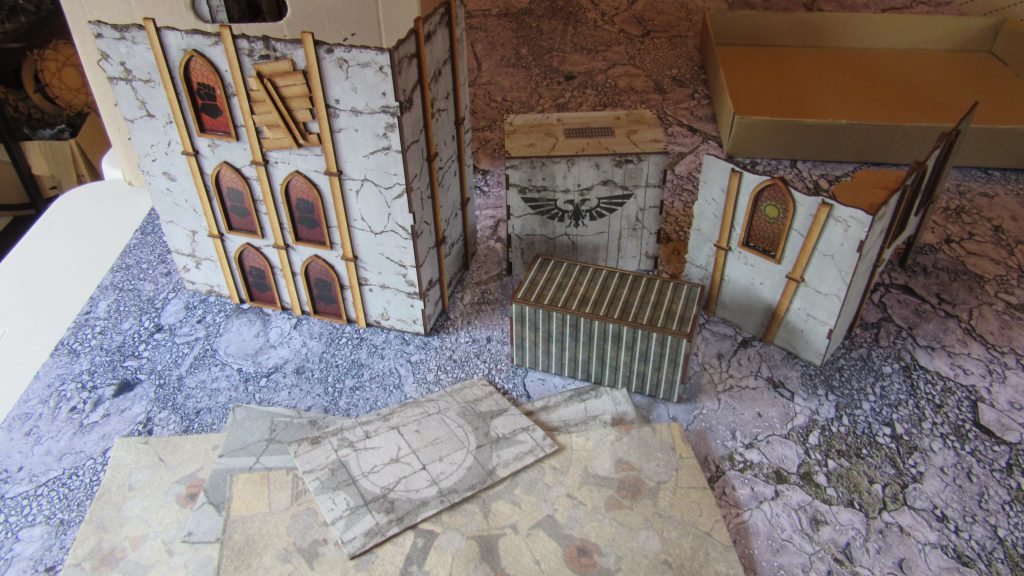 My building blocks
As mentioned up top, we’re partnered with Bandua Wargaming as our UK terrain supplier, because we think their stuff gives the best balance of price, aesthetics, logistics and competitive utility. Going into the preparation for this year’s events, we had a full range of their WTC ruins, mats that match the GW area sizes and a selection of wall and crate sections. This provides a wealth of stuff to work with, but what it doesn’t do is allow us to directly use either the UKTC maps or GW maps. The UKTC maps require a very specific set of shapes, and stop working fairly quickly if you start substituting pieces, but why not the GW ones - after all, we have the mats?
The reason for this is a bit more subtle, which is that the GW maps actually rely on some of the areas being fairly sparsely populated with actual physical terrain pieces to work. While the Bandua WTC ruins fit on the mats (and indeed, when we get to our maps you’ll see that we use them like this), because they’re solid along one side, if you put them directly onto GW maps you’ll find that even medium-sized vehicles start being unable to navigate the table. Bandua have some new sets designed specifically for the GW layouts coming soon (watch this space for a review), but these weren’t available at the time I was planning the Spring GHO UK.
There’s also the question of what we’d put on the 4”x6” areas - we could do crates or walls, but that would make the movement issues even worse. That’s definitely not what we want, because that runs directly counter to my other big motivation here - gameplay goals.
The Philosophical - Gameplay Goals
The other big reason to make your own maps is because there are one or more things you don’t like about pre-existing packs, and you have the budget and the hubris to try and do better. In our case, my broad reasons for not wanting to use the three pre-existing packs that were out there at the time were as follows:- WTC: Easiest to discard - we’re not running a teams event, and I prefer not using these for singles play.
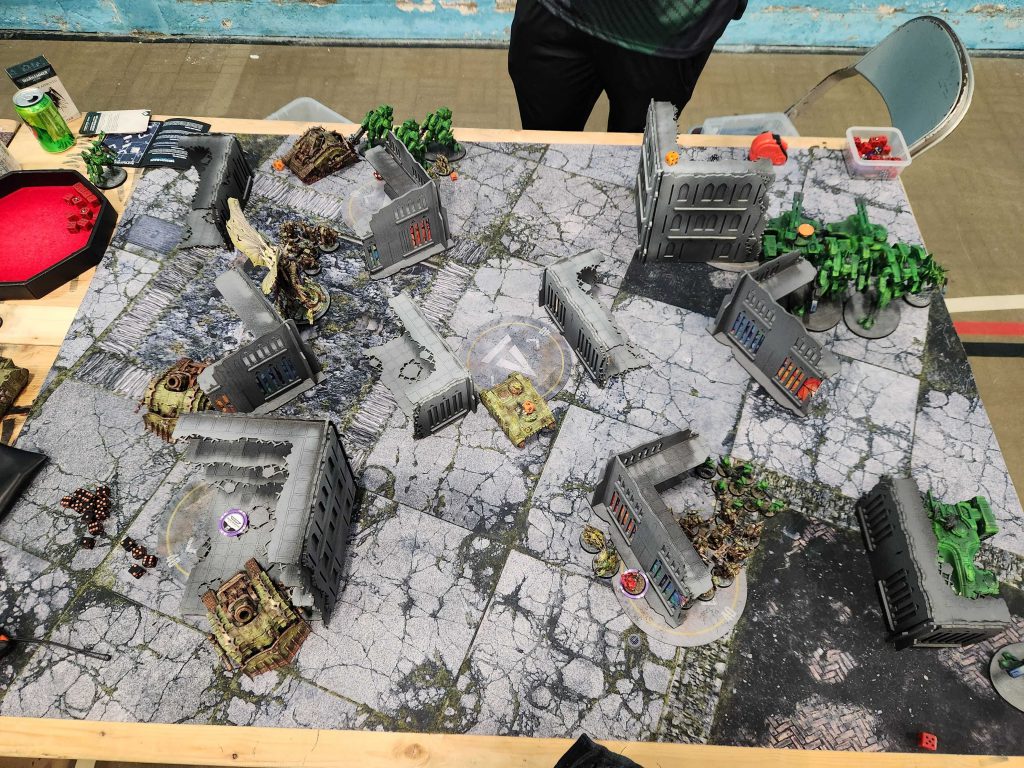 Credit: TheChirurgeon
- UKTC: The UKTC maps make Fixed Secondaries stronger than I like with a very well protected position to Deploy Teleport Homers near the board centre (a small ruin that the opponent needs to get right around to prise something out of). You can see this in Rob's photo from the recent Oxford GT above. In addition, they were hard to move larger tanks like Land Raiders and Baneblades around, and I like these models being available to players - it's been very noticeable that you see these much more in the US meta than the UK. More recent versions of the pack have made some improvements on the latter point, but still don’t support super-heavies as well as I’d like.
- GW: I don’t like how completely some of the maps cut off interaction across the mid-board (especially 1 and 4), and as-per the practical section we’d hit the same mobility problems for large vehicles if we used the ruins we had on these. I also don’t like how sparse some of the areas are on these maps, as I find it makes staging bigger stuff too easy and too binary.
There’s also another factor at play - variety. Terrain packs being commonly used cuts both ways, and players who attend a lot of events can get bored of them, especially if they encourage/discourage some types of units. As long as you’re confident that you can do a good job, plenty of people will enjoy the challenge and experience of something new.
So with all that, we’ve decided we’re going to make some maps; what’s next?
Setting Your Goals
Before we put terrain to table or pen to paper, we should have a clear idea of what we’re setting out to achieve. Quite a lot of this will stem from the reasons you’re doing this - your number one goal is pretty much always:- Make effective use of the terrain I have available given the number of tables at my event.
Once you’ve got that out the way you can work on the second universal goal, which is:
- Meet the “hygiene factors” for a good game of competitive 40K.
 Plague Marine. Credit: Pendulin
In my opinion, this is hugely relevant to many aspects of running a good 40K event, and map design is no different. Your first priority is ensuring that your maps don’t drop the ball on any of the fundamentals that go into a good game of 40K, because that will ensure they’re not a source of dissatisfaction to your players. If you get that right, then all the motivators that they (hopefully) encounter during the event are going to drive their overall satisfaction with the experience, while if you mess it up then it doesn’t matter if they play great opponents at a great venue and win a great prize - they’re going to remember that the maps were a bit shit. That matters both because it means they had a worse experience (and I generously assume you want your attendees to enjoy themselves) and because it can create negative word-of-mouth publicity that might make it harder to fill events in the future.
You can (of course) aim higher than the bare minimum, but it’s useful to understand roughly where that sits so you can make sure you’re meeting it. My rough opinion is that the hygiene factors for a map in 10th Edition are:
- You should be able to hide lots of small models and at least some large models in your deployment zone from enemies in the opponent’s deployment zone.
- You should be able to hide at least some small models more than 6” out from your deployment zone towards the mid-line (or in non-home quarters on Search and Destroy) from enemies in the opponent’s deployment zone.
- From any quarter of the board to any other quarter of the board, there should be at least some lines that are obscured by terrain sufficiently that you can hide one large model from one large enemy model.
- Models up to reasonably large size should be able to navigate most parts of the board, and must be able to leave Deployment Zones.
- Terrain should be placed around no-man’s land objectives so that holding them isn’t too safe (particularly for larger models), and so that sightlines in-between them aren’t too open.
Get those right, and you will create adequate conditions for a good game of 40K. Get them wrong, and some players are going to have a bad time.
Once you’ve got those down, you can start adding more nuanced goals on top of them, aiming to turn a decent map into a great one. Checking back to what I said I didn’t like about UKTC and GW maps, there are broadly three additional goals I’m aiming for, in this order of priority:
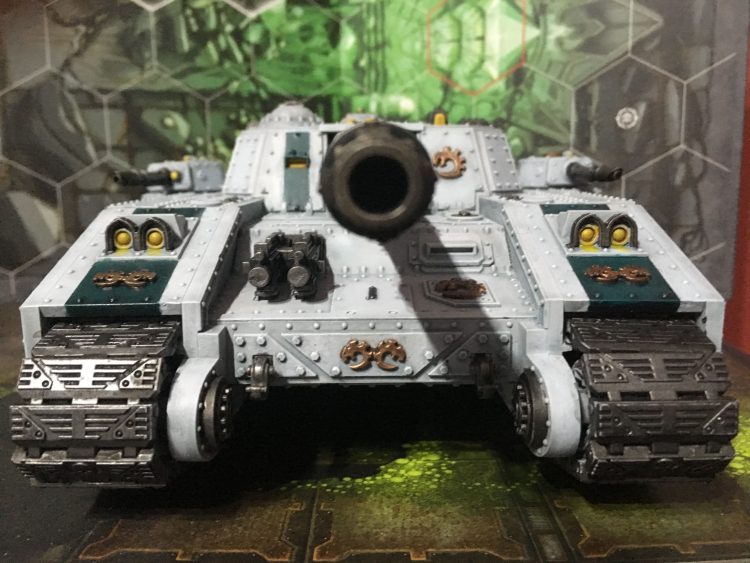
- Make the board navigable for models in the Monolith/Baneblade range, going further than the minimum included in the hygiene factors.
- Avoid making Deploy Teleport Homer too safe to score in the mid-board.
- Avoid completely blocking sightlines through the mid-board.
- Aim to have one map per day, so players aren’t having to reset the table between games. That means each map needs to support three different missions.
 Credit: Jay (Steel Mentor)
If I can hit these while designing the maps, then great, but only if they don't compromise the hygiene factors. The only one of these that is “mandatory” to hit is point 3, because we knew at least one participant was attending with a Baneblade, and even for that I’ll make compromises on just how much of the board is navigable if I don’t think I can do it without messing up on a core principle. It feels like all of this should be doable though - so we’re ready to go!