 This website uses cookies.
  Start Competing: Unit Roles in 9th Edition - Introduction
That means that many of the certainties that underlay our tactics guides written during 8th Edition no longer hold true, and alongside the ongoing updates we're making to faction-by-faction Start Competing guides, we're also pleased to say we're now ready to start pushing out some more general strategy guides, starting this week with a series looking at the roles units play on the battlefield in competitive 9th Edition, and how that impacts on list design for games played with the GT2020 mission pack.
Today, we're going to introduce the concept of unit roles, and talk about how they've changed in the transition from 8th to 9th. Then, we'll deep dive on each of the primary roles identified in a separate article, looking at what it is, how to use it, how to counter it, and an army list that shows off a strategy built around it. The first of those will be going up alongside this article.
Once we've finished our tour through all the roles, we'll finish off by applying them to do some list doctoring - taking some lists aimed at competitive play, breaking down what roles the units in them are fulfilling, and identifying whether we can apply these principles to tune them up.
So - have a read of this introduction then click over to the article covering the first role (which can be found here), and make sure to check back every day for more.
What is a Unit Role?
 Credit: Robert "TheChirurgeon" Jones
Where do Roles Come From?
In order to win a game of 40K, you need to have a battle plan. A unit's role describes the way(s) it can contribue to the successful execution of a battle plan.That means that the available set of roles for units to fulfil is, fundamentally, driven by the victory conditions of the mission they are being used in. Since you win games of 40K by accumulating more victory points than your opponent, in games played with the GT2020 mission pack unit roles will be defined by what you need to accomplish to achieve high scores on the primary and secondary objectives. As it turns out, this generates some very different incentives compared to games played with competitive mission packs in 8th Edition (especially the most popular ITC format), and as a result 9th Edition's set of roles looks quite different to what went before.
We'll come back to exactly what roles do emerge from 9th Edition's missions, and how and why they are different to 8th's, but first let's identify how they emerge and how units fit into them.
Identifying Roles
Units can do a lot of things on the table. The majority can move around and claim objectives, most can inflict damage on the opposition in some shape or form, and a whole laundry list of abilities and special rules across the game's hundreds of datasheets provide plenty of other capabilities and tricks. In a vacuum, however, these things wouldn't mean anything. The reason that what any given unit can do matters, is what results it allows you to achieve on the tabletop, and whether those results are going to contribute to scoring points effectively in the mission.To find a unit's role, you want to consider three things:
- What things is this unit best at accomplishing?
- Is the unit effective enough at accomplishing those things to achieve valuable results against a capable opposing list?
- Is the unit comparably efficient or better at accomplishing those things than other options available to me?
Building Roles into an Army list
 Credit: Robert "TheChirurgeon" Jones
Once you have a set of roles that the units available to you can fulfil, you essentially have a set of building blocks that let you:
- Work out a plan to achieve a high VP score.
- Work out how your opponent(s) might be planning to do the same thing.
- Execute your own plan.
- Thwart your opponent's nefarious designs.
Is a Unit's Role Fixed?
No. Generally when you are adding a unit to your army list you will have a role that it particularly excels at in mind, but that doesn't mean that's the only role a unit can ever play, and indeed being able to fulfil multiple roles is extremely valuable, moreso than ever in 9th Edition.Roles can shift both based on how you combine elements in your army list, and what happens on the tabletop. Different combinations of unit size, equipment and supporting elements can drastically change what a unit is best at, and some particularly valuable rules or loadout choices can let a unit seamlessly transition from one role to another as circumstances dictate. Once you hit the table, meanwhile, your pre-event plan may not survive contact with the enemy - in both good and bad ways. The positive version of this is that you might find one of your units is especially good at performing outside its normal role against certain opponents (or once enemy units that prey upon it have been removed), giving you extra flexibility. The flipside is that you might find yourself in a do-or-die situation where you have to gamble on using a unit outside its normal roles because all your specialists have suffered a series of tragic, bolter-related accidents.
In general, you want to have a clear understanding of:
- What's this unit's main role in my army list?
- What other roles is this unit OK at performing?
- Can I make any choices that increase this unit's flexibility?
How Have Things Changed from 8th?
8th Edition had a pretty large number of plausible roles for your units - in fact, when we put the list together we identified 12 distinct roles a unit could play in your army. They're listed in the drop down below if you want to remind yourself of what they were quickly.
At a very high level, the following shifts have have occurred in 9th:
- There are fewer roles overall.
- Each role tends to be broader in the units that can fit within it.
- Armies need to pack a greater proportion of the overall number of roles in to succeed.
- Changes in mission design.
- Changes in army list construction.
That takes out a couple of roles, but the real driver of the significant rearrangement of the rest of the list (as we'll see in a second) is the change in mission design. 9th's scoring rules for primary and secondary objectives combine with the shorter game to mean that the kind of purely reactive gameplan that you could build around in ITC 8th simply doesn't work in 9th.
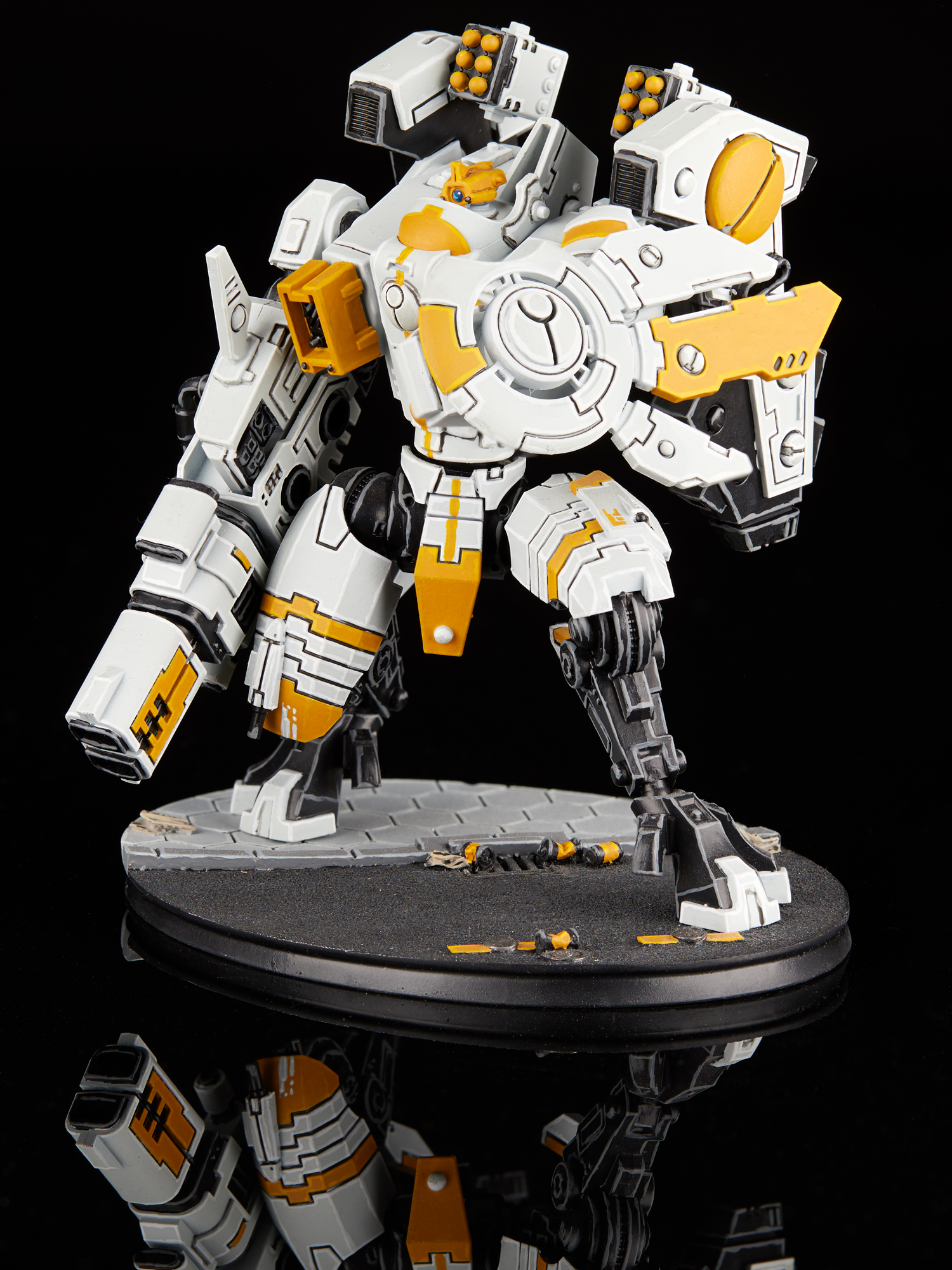 Tau Riptide. Credit: Jack Hunter
A pretty common gameplan in ITC 8th went something like the following:
- Pick a mix of kill-focused secondaries and positional ones that can be scored with sacrificial/hard to stop units.
- Let the opponent make the move to mid-board objectives early on, while carefully securing a single home objective for score one.
- Annihilate the opposing forces over 3-4 turns, staying level by getting Kill More to their Hold More.
- Wrap up with two 5pt turns at the end of the game for an easy win.
Overwhelmingly, 9th's missions want you to be proactive in how you approach their objectives. If you want to consistently rack up wins, your list needs to have a coherent plan for how you're going to score 75pts+ across primary and secondary objectives, and that plan needs to plausibly hold up pretty much whatever your opponent puts down. On top of that, there are no primary points to be had for killing stuff, and scoring objectives means holding them through your opponent's turn, so you can't react to moves made by your opponent and immediately score points any more - you have to lay down a longer-term plan that will robustly rake in VP over time. That doesn't mean you can ignore your opponent's moves, mind, in fact quite the opposite, because the other big shift in incentives 9th brings is that the price of "ignoring" a turn of objective play is way higher.
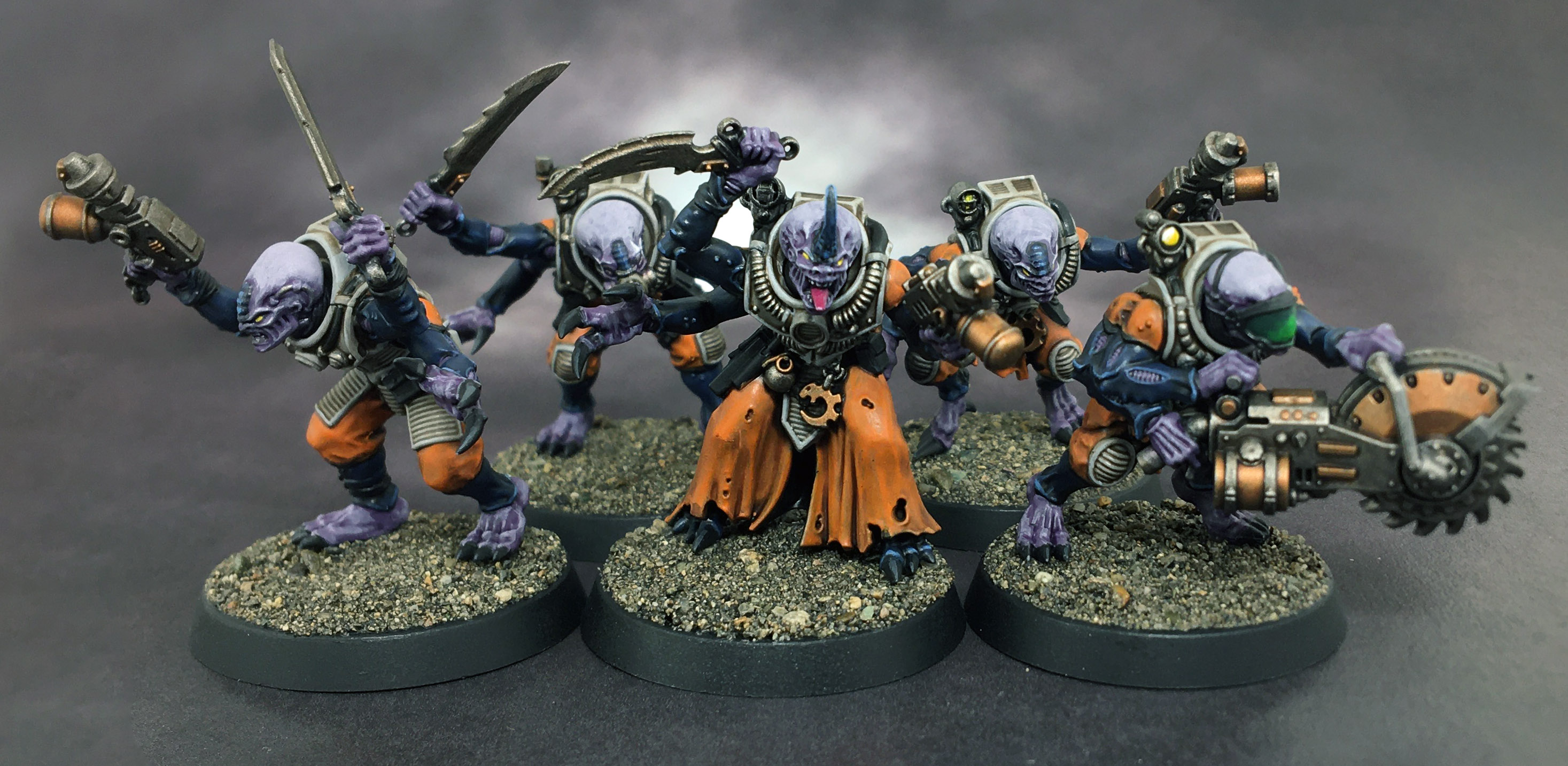 Acolyte Hybrids
Credit: Pendulin
That makes sense just on the numbers if you think about it - in ITC 8th, you had six turns of scoring to play for, and if you were playing a list that could reliable Kill More, ceding any attempt to score Hold More or the Bonus on the first turn would still only result in the VP for the primary mission being 4-3 in your opponent's favour for one of six scoring windows. Fail to properly contest turn one in 9th, with all the points now being objective based, and your opponent usually goes up 15-5 at the start of the second battle round, and that's bad news for you. They can now reach max points without ever having to contest "Hold More" again, while you need at least two turns of Hold More to do the same, giving them far more flexibility in how they address future turns. None of that means that it's always wrong or unsalvageable to allow a 15-5 first turn to happen against you in a given game, but as a consistent strategy it leaves much to be desired, and it's once again no coincidence that Genestealer Cults (who traditionally made minimal attempts to contest turn 1 in 8th) are another faction that's been having a rough edition so far.
All of this is further compounded by 9th's secondaries and objective placement. Far fewer secondaries these can be racked up for "free" if you table the opponent (especially after the January FAQ), and many of the positional objectives need you to engage with them for most or all turns of the game to get max points. Objectives themselves also use fixed placements that tend to reduce the number you can "safely" secure in a given game, forcing you to fight much more aggressively for primary points.
Everything adds up to mean that most gameplans in 9th are built from a pretty similar template:
- Start contesting the mid-table straight away, or by turn 2 at the absolute latest.
- Sustain that engagement all the way through the game.
- Interfere with the opponent's plan to do the same, however they intend on doing it.
That, I think, should bring us through the stage-setting we need and take us onwards to discussing how this all hashes out and gives us our list of roles for 9th.
9th Edition Unit Roles
9th Edition's more focused and consistent battle plans translate to a smaller set of roles that can be fulfilled by broader ranges of units, and in total I think there are broadly six roles that see enough use to justify a slot on the list. In 8th the majority of the roles divided up into "offensive" and "positional" categories, but I don't think that's appropriate for 9th. Instead, I'm grouping four of them as "Primary" roles, which are the building blocks that you need to build effective 9th edition game plans, and two secondary roles, which can be added in to list when required to either augment the primary plan or shore up scoring options.The roles we're going to talk about are as follows:
- Primary Roles:
- Position Holder
- Brawlers
- Elimination
- Attrition
- Secondary Roles:
- Objective Utility
- Force Multiplier