 This website uses cookies.
  War Zone Nachmund GT Mission Pack: The Competitive Review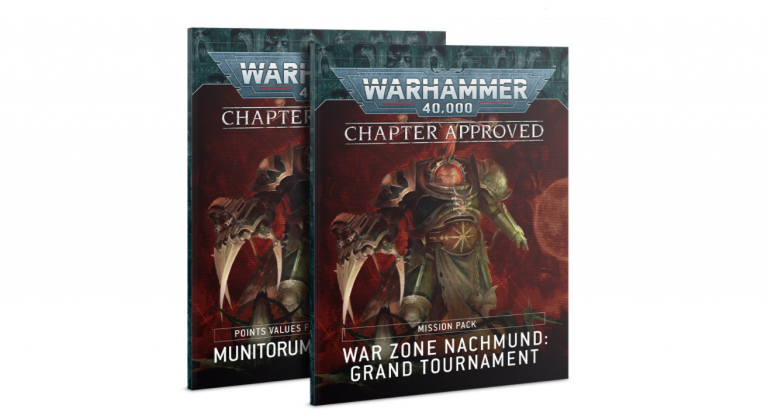
In this article we're going to take an in-depth look at how War Zone Nachmund shapes the competitive landscape, how it affects different armies and playstyles, and what it means for players looking to tackle the new environment. We'll also be covering the points update in a separate article, and looking at the impact of the new GT missions pack on each of the game's major factions separately.
As we go through this we'll be looking at the Missions Pack through the lens of existing competitive players and focusing on what's changed. We'll also be doing a separate article as a primer on them for new players and players new to competitive play in the coming weeks.
Before we get started we'd like to thank Games Workshop for providing us with an early copy of War Zone Nachmund for review purposes.
Welcome to War Zone Nachmund
If you were disappointed by the relatively small number of changes between the 2020 and 2021 GT mission packs you won't be disappointed by Nachmund. There are a number of major changes here, from 18 all-new Incursion and Strike Force missions to new faction secondaries and adjustments to old ones to changes in army construction and the pre-game process. Almost every aspect of competitive play has been tweaked in one way or another here and each of these changes is bound to have major impacts on competitive play.
Two quick things to note about the physical book itself before we dive into the details of what has changed in the rules:
- Similar to the GT 2021 Missions pack, the book is not spiral bound (boo)
- The GT Missions pack does not include the Core Rules, unlike previous missions pack. We're of two minds on this. On the one hand, reprinting the core rules without updated errata and FAQ items is kind of pointless. On the other hand, it was nice to have those handy.
This means the book is quite a bit lighter than previous editions and the book is almost all content, with very little fluff. The content is also much fresher this time around - if you'd gotten bored with the GT 2021 missions or felt that they'd gotten stagnant needed a major refresh well, you're not going to be disappointed here.
Army Construction
 Credit: Robert "TheChirurgeon" Jones
War Zone Nachmund introduces a big change to the rules for building armies that's going to have pretty wide-ranging impacts. In games played with your mission pack, you can only make a single choice for how you replace each <faction> keyword in your list, meaning that you can no longer bring (for example) multiple Ork Clans in the same army, with the following exceptions:
- Freeblade and Dreadblade models, meaning you could bring (for example) a Questor Mechanicus Freeblade alongside a Questor Imperialis army, and the Freeblade Lance is still entirely free to be On Its Bullshit.
- The <ALLEGIANCE> keyword in Daemons, so mixed god Daemon armies are still A-OK
- <MARK OF CHAOS> on Chaos Space Marines, for much the same reason.
- Named characters where the keyword is pre-selected (note: this is implicit in the way the rule is worded but explicitly stated in some designer commentary at the start of the book and the WarCom articles - we appreciate GW heading off any arguments about this at the pass!).
This puts a stop to “subfaction soup”. Cross-faction soup is still permitted, as different armies will have different <faction> keywords to replace, and a few factions like Drukhari have multiple different <factions> within them (and again here, the choice of example makes clear that they can definitely have one of each), but plenty of current competitive builds make use of multiple subfactions, and this is going to have substantial impacts on the metagame.
It's maybe not a huge surprise given the trend over the edition, and probably a relief for GSC and Custodes players as their new books harshly punish subfaction soup, but it's certainly going to shake things up. Taking a glance at the Competitive Innovations List Archetype page, there are a lot of builds that now have a ticket booked for a trip direct to the Rogue's Gallery, with notable impacts as follows (before we get to points changes, which we'll be looking at in separate articles):
- Grey Knights now cap out at four Dreadknights, as you can only have one Grand Master per Brotherhood, and many of their successful lists were using multiple Brotherhoods to squeeze in the fifth big guy. Prescient Brethren/Swordbearers is currently the premium build, and there's a genuine choice as to which way that breaks, and potential for Rapiers to get a look in too.
- Adepta Sororitas lose a lot of builds, likely bringing mono-Bloody Rose and Martyred Lady lists to the fore, though Valorous Heart has also seen some use and may gain from some of the discounts on tanks.
- The best versions of the Ork Speed Mob lose their trick of combining Evil Sunz with Freebooterz, and the Deathskullz-splashing version of Goff Pressure list goes away. They also get quite a few points tweaks, so it's a lot less clear exactly how they'll shake out than for some other armies. The rules as written do also need a quick FAQ to add Specialist Mobs to the exemption list, but we don't for a second believe that this was intended to just ban these outright, and hope TOs let players use these as normal until one arrives.
- The Tyranid Hive Guard Spam builds that used both Leviathan and Kronos go away, and few tears will be shed.
- The Thousand Sons Time/Duplicity build, which by volume of big event wins is overwhelmingly their best, dies, and there's real cases for pivoting to either in a mono-Cult world.
- Chaos Knight lists using a mix of Infernal and Iconoclast War Dogs take a knock.
- Adeptus Mechanicus lose access to Mars/Lucius, which is pretty rough for them, though re-configured builds of Mars Veteran Cohort have started popping back up.
- Technically Drukhari take a mild hit as this closes down double Trueborn builds for good (though they were already mostly dead) and prevents you combining Dark Technomancers and Artists of Flesh, but given they're now the faction with by far the most flexibility to combine factions of anyone, we hope Drukhari players will have the good sense not to complain about this.
Numerous factions getting their best builds closed off is obviously good news for any armies that already favoured mono-faction options (especially Marines and the latest books), and also good news for players who just didn't want to paint multiple subfactions.
 Wings: I think this change is a big shakeup, and I think it's going to suck for some of the early-mid edition books, but I'm in favour of it in general, and have been impressed enough with the internal subfaction balance in recent books that I think it will end up good for the game overall. I honestly somewhat expected this to be changed at 9th Edition's launch, as I kind of got the impression that mixed subfaction lists were never really something that GW expected to be a big thing or particularly liked, and that impression has only increased over the course of 9th as the rules against it have gotten harsher and harsher. We've finally arrived at the logical conclusion of that, and my basic feeling is that it's better late than never, and after the initial shock this is going to create a more interesting game going forward.
The reason there's going to be a shock is because some of the earlier 9th books still have the 8th Edition issue where some subfactions feel like more of a complete package than others, and a lot of the list diversity comes from mixing up multiple subfactions in ways that patch the gaps in each one. I expect Mars to fully take over the Adeptus Mechanicus at this point, and a lot less wild Adepta Sororitas combos as a big outcome from this. However, the positive side of this is that it shuts down some of the multi-subfaction builds that just end up as obviously superior to any single choice, and helps restrictions like the Grey Knight Grandmaster cap actually work as rules rather than guidelines. As I write this there are intense debates on our Discord as to which Genestealer Cult option is best with wildly diverging opinions and different builds being thrown out, and I think that's much more fun than where some other factions have landed.
It is also good for players with limited time and/or budget, because if we're brutally honest, trying to maintain a competitive painted collection for an army where mixing and matching was the norm was a nightmare, pushing you to either paint stuff at a much less satisfying level than you'd like or have to do extremely unsightly things to base rims. I'm obviously in a somewhat unusual position where a huge amount of my hobby time each week gets eaten by this website, leaving me very limited painting bandwidth, but if I never end up in a situation again where I have the nagging feeling I could improve a list solely by painting one unit a different colour, I'm going to be happy.
The Pregame Process
 Credit: Robert "TheChirurgeon" Jones
Although not quite as massive as some of the other changes in Nachmund, there are a few key changes to note in the pregame process for competitive play.
- Secondary selection now happens after rolling for attacker/defender and choosing deployment zones. It still happens before you declare reserves and transports, but now you'll know who's deploying first when you make your secondary picks. That may be helpful in situations where both players have units that can deploy outside of deployment zones, for example but in most games it won't matter.
- You now have to pick at least two secondary objectives from the Nachmund Secondary Objectives. We'll dive more into these secondary objectives later but the short version of this is now you can only have one faction secondary. You may still be able to choose from two books if you're a Space Marines chapter, but you won't be able to take more than one secondary objective from a Codex. This really only hurts Dark Angels.
- Fortification Deployment Rules! Fortifications get fixed! Not being able to consistently legally place these has been a long-term bugbear for players, and there's now a rule for this. You have to deploy your Fortifications first, but if they won't fit anywhere on the table, you now get the option to delete one piece of Terrain that's within (only needs to be partially) your deployment zone in order to make space. This should flip things round so you can now almost always bring one and expect to set them up on the table, and we can assure you that even now Gunum is turning a Fortress of Redemption around in his mind palace, examining it from every angle and contemplating how to use it to do something bizarrely effective.
- The Rules for Conceding have changed. Players can still agree to end a battle early at a mutually agreed point, but now if one player wants to end the battle early and the other does not, the player conceding removes their models from the battlefield and scores 0 points while the other can calculate a score with objectives scored so far. If their score is less than 60 points, then they score 60 points, plus 10 more if their army is battle ready.
The Missions
 Credit: Robert "TheChirurgeon" Jones
War Zone Nachmund's missions represent the biggest shakeup to the GT pack formula since the start of the edition via two key changes:
- Primary scoring now has two components - your standard Take and Hold or Domination scoring, albeit for fewer points (4/8/12) and a second, mission-specific primary objective that can be scored for up to 15 additional points, still to a maximum of 45 per game.
- Mission secondary objectives are gone, so everyone is now working from the core list plus their Faction options.
In addition to these big changes, there are a few smaller (but still important) general tweaks:
- Some of the Secondary Objectives have changed considerably.
- Factions that don't yet have a 9th edition codex and aren't landing in the near future (or at least we assume that's the case for some of these) have been given a single faction-specific Secondary objective choice added in this book. Good - this should have happened earlier, but we aren't going to say no to it at this point.
- A higher number of missions now have some special rules, many modifying how Command Points are gained during the course of the game.
- There are fewer Domination (hold 2/3) missions in the pack this time around - only two rather than three - and both of them are missions with 6 objective markers.
- We'll look at the Secondary objectives in detail later in the article, but one of the impacts to the change in Primary and the introduction of mission special rules is that which of the nine missions you roll up has more impact on what's going to happen in the games. In addition, there's quite a bit more variety in the “tempo” of the alternative Primary options than we expected based on the two missions GW previewed for the US Open finals, which can create some very different scoring patterns.
Both of the previewed missions - Secure Missing Artefacts and Recover the Relics - had special Primary conditions that were capped at a predictable 3 VP a round for each player, but that's not true for all of them - there's five that broadly track at a maximum of three per turn, but four that mix things up, two back-loading the scoring to end game, one that you can score more aggressively but can also lose points on, and then Tear Down Their Icons, which is by far the most “out there” (in a good way).
That means to talk about the impacts of these we do need to quickly tour through roughly how each works (something that if you're reading this, you're probably going to become intimately familiar with over the next six months).
- Recover the Relics was one of the previewed missions, and uses the Retrieval Mission six-Objective map with Take and Hold Scoring. It messes a bit with command point acquisition, forcing you to claim a no-man's land objective to get one, and rewarding you for stealing the opponent's, and gives you up to three Primary VP per battle round for killing your opponent's stuff.
- Tear Down Their Icons uses the Priority Targets diagonal deployment with Take and Hold Scoring, and the most unique and hilarious alternate primary scoring. In each turn, one of your units can perform an Action to plant a bomb in the opponent's half of the board, creating a special objective marker, and one of your units can defuse a bomb in your half of the board if any have been planted. At the end of the battle, you get four points for each bomb that detonates in their half of the table. Wings: Incredible, no notes.
- Data Scry-Salvage is a new version of Vital Intelligence, using the same map and a modified version of the existing Secondary as the alternate scoring condition, earning you up to three points per turn. There are also a few changes to how objective lock-in works, only working on mid-table ones and requiring you to have ObSec.
- Abandoned Sanctuaries is designed to be a mid-board bloodbath, using Dawn of War deployment and Take and Hold scoring with a new objective map that puts three across the middle of the table, and one in the centre of each player's deployment zone. The Secondary rewards either fighting for the centre objective or blasting the opponent off it in a progressive fashion, with a big five point bounty for holding it at the end of the game. In addition, this mission prevents you from using any scout deployment or pre-game/start of the first battle round moves to push out of your deployment zone.
- Conversion is one of two missions that use some of what Sweep and Clear used to (both on its map), this one drawing on the Secondary Objective to create the alternative primary condition - you get points for controlling objectives in no-man's land or your opponent's home objective, but you now lose a point if you fail to control your home objective (and this one doesn't use lock-in). In addition, in this mission your Warlord has to be on the battlefield (or in a transport) in order to get your Command Phase CP.
- The Scouring returns next, with considerable changes (so maybe hold off on those boos for a second). It's now Take and Hold rather than Domination, and uses a much more normal Hammer and Anvil deployment zone, so there should hopefully be fewer complete blowouts on the primary. It's also another one where the alternate primary condition is pretty much a straight import of the old secondary - you can scan one of the five objectives each turn, and get 3VP for each.
- Tide of Conviction is another new Dawn of War mission, and another one that's designed for maximum bloodbath potential. It's got six objectives, with four arranged in a parallelogram in no-man's land, and uses both Domination scoring and the most back-loaded alternate primary in the pack (or vying with Tear depending on how you count it), with two points available on each of turns 1-4 for holding an objective in your opponent's half of the table, and a massive eight you can score for doing so at the end of the battle.
- Death and Zeal is the other half of Sweep and Clear, using the map and objective lock-in but a different alternate primary condition, rewarding you for gaining control of a new objective and blowing up your opponent's stuff that's holding them
- Secure Missing Artefacts is our final entry, and was the other one previewed, a direct successor to Priority Targets. It adapts the previous Secondary Objective to be the alternate Primary condition, but makes the sensible choice to allow each player to choose which of the objectives in their opponent's deployment zone is the priority target, making it a little harder to score.
Nine new missions - so how will they play?
Wings: With two exceptions, I'm a big fan. Splitting out the alternate primary conditions creates more decisions on the table and makes each mission matter more, and for me the fact that they aren't all strictly 3VP a turn is a pleasant surprise, especially as where they do diverge they tend to favour the player going second, helping to augment the existing catchup mechanism of better turn five scoring for them. I think there's some pretty healthy exploration of what you can do on that front, with Tear Down Their Icons being my particular favourite. I really can't say enough nice things about this mission, having had a play with it, and I think it's the single best use of the design space Actions as a mechanic open up that we've seen all Edition. More of this sort of thing.My only holistic concern here is whether it turns out to be too easy to push your primary score towards the maximum - I actually wonder if the objective primary should now be 4/8/10 instead of 4/8/12? We'll quickly find out if that's a concern or not, but I like the core mechanics at play here enough to wait and see. Also a very big fan of the fixes to Fortifications - datasheets should either be usable in Matched Play or they shouldn't, not be stuck in some weird limbo where you have to ask a TO about the deployment maps first, so this change is excellent.
In terms of things I don't like, it's basically just two of the missions. Data Scry-Salvage imports all the problems of Vital Intelligence with an alternate primary condition that might make things worse because it's enormously favourable to the player going first - it is quite likely to be an automatic 3VP turn one for player one (unless the opponent has scout deployed ObSec stuff), and is never that easy ever again. This map with Domination scoring already generated extremely polarised primary scores between winners and losers and I don't see this new version being any better. Also, the map still makes my eyes bleed. Don't think I've forgotten GW.
The other one I don't love is Abandoned Sanctuaries, just because I'm never a fan of turning off some kinds of abilities arbitrarily for one mission. I think this one probably still plays fine, as disabling pre-game moves isn't anywhere near as bad as the nadir of this particular design trope (Narrow the Search in 8th), but 9th is meant to be all about building an army to a particular plan, and sometimes just disabling some unit tools at a mission level doesn't fit with the trends. Oh also, fun tip - the only pre-game move that does still work here is Genestealer Cult's They Came From Below upgrade, because that happens either in the Command Phase or the opponent's Movement Phase, so is after the cut-off where these effects stop being prevented. Don't assume you're safe from that unit of Genestealers getting right in your face!
Neither of these issues stop these missions being playable (though I'll be interested as we track the stats as to whether Data Scry Salvage does show significant polarisation) and overall I definitely feel more excited to play some events with these new missions than I would if we were continuing with the old set, so it's clearly a success overall (especially as I think the Secondaries are an improvement too).
 TheChirurgeon: I have mixed feelings about these. I like that they've decided to go for more bold changes and mission-specific differences - there's a lot more variety to how these will play than in the 2020/2021 missions. I don't love how they've chosen to implement those changes across about half of these, and I'm just generally not a fan of interfering with a player's CP generation. We'll come back to that in a second.
What's Good: Missions feel different. The new primary scoring is great - it gives armies a lot more to do and makes the mission actually matter in every game, not just the games where the mission secondary is easier to score. Having 4/8/12 on primary is going to be interesting for go first win rates as it means player 1 is less likely to max out primary scoring by turn 4 and so may have more scoring to do on turn 5. I also generally like the deployment maps a bit more this time around - they seem like they were designed to all use a single GW terrain layout (Day 2 and 3 of NoLA/Austin), with minimal tweaks, and having more missions that can use the same terrain layout is a big plus for tournament organizers who can't shift terrain around between every game. And as a Death Guard player I generally like the “Search and Destroy” style deployment maps, so I'm happy to see there are two of them now, but I'll likely regret that feeling since 18” is probably too small a starting distance between armies.
What's Not Good: Having a mission that turns off scout moves and forward deployment is just a terrible, awful idea that will tip the balance for too many armies. Generally, missions shouldn't remove abilities that players pay points for - if you can't make a mission that can handle pregame moves and forward deployment, don't have that mission. I'm also not a fan of removing a player's CP generation for any reason - while it incentivizes a player to be more aggressive it also makes comebacks much harder, as the player already losing badly now has fewer resources to work with. Too many games in 40k are foregone conclusions early on and the mission rules should help avoid making more of them. I'd have rather seen bonus CP to the aggressor, or just not working with CP at all since the value of CP varies wildly by armies. I also really don't like Leading from the Front rule on the Conversion mission (you only generate CP for being battle-forged if your warlord is on the table or in a transport on the table) - it gives me horrible flashbacks to Kill Team 2018, where the best move was to keep your leader hidden and out of reach. It's a major problem for armies that actually use their warlords for combat, and discourages them from using the pieces they paid for.
What's Going to be Weird: The one piece I'm neither up or down on at the moment is the three missions that have new actions associated with them. I generally like actions being a bigger part of the game, and having to do them more often but having more units that can do them is good. But I do wonder how they'll work with armies that already needed to do actions on a semi-regular basis, as suddenly the action economy will become something very difficult to manage - it'll advantage armies that don't depend on an action secondary, or who have more units of just absolute chaff. I don't know how this one will play out, though. Could be massive, might not matter. An area where I'll be interested to see how the data shakes out.
Wings: For what it's worth, I actually think baking Actions into missions as a mandatory component is one of the better ways to use them. Actions in theory open up quite a bit of design space, but in practice most iterations of them thus far have been extremely binary, generally being a button you press when it's guaranteed to give you points, and often happening in isolation from what the opponent's up to. Tear Down Their Idols creates a genuinely interesting sub-game, and makes these feel interesting and interactive. I would have loved to see something similar done with the new version of the Scouring - have the score for each point you scan be higher, but allow players to transfer them back and forth by flipping ones their opponent had acted on. Having Actions in missions also helps ensure anti-Action abilities have some intrinsic value in a way that they just don't most of the time, a nice side benefit.Secondary Objectives
 Credit: Robert "TheChirurgeon" Jones
Along with the updates to Primary scoring, the War Zone Nachmund pack brings along with it the latest updates to Secondary objectives, making a reasonable number of tweaks to the core ones and providing six factions with an extra option to tide them over until their books arrive.
Now, in terms of the core Secondaries we've already done a run-down of these when they were revealed at the GT finals, but just to refresh your memory (and include a couple of things that were missed in that article) the updates are as follows:
- Engage on All Fronts (rewarding you for having units in three or four quarters of the board) can only be scored by units that either contain 3+ models or a MONSTER/VEHICLE.
- No Prisoners (rewarding you for killing lots of wounds of non-VEHICLE/MONSTER units) gives you a bonus point if you kill 50+ wounds, or 2 bonus points if you kill 100+, making it easier to achieve maximum (or respectable) point totals on this secondary objective.
- Bring it Down (rewarding you for killing VEHICLES and MONSTERS) changes its thresholds a bit, bringing the threshold for 2VP down to 10W (the most important change here) and the 3VP threshold down to 15 wounds.
- Retrieve Nachmund Data (RND) (rewarding you for performing an Action in each table quarter) replaces Retrieve Octarius Data, now being able to be performed by Bikers, but requiring you to roll equal to or less than the number of models in the unit performing the action to complete it (subtracting 1 from the result if the unit attempting the action has the Troops battlefield role), meaning that single-model units or things like Death Cult Assassins are much less good at this now.
- Deploy Teleport Homers (rewarding you for performing an Action in or near your Opponent's deployment zone) now completes at the end of your turn if the unit performing it has the Troops battlefield role. In addition, we thought from the previews that this needed 3 models minimum to complete, but that is not the case, making this a potentially quite compelling alternative to RND for some armies.
- Investigate Signal (rewarding you for performing an Action in the board centre, and clearing the opponent out of it) can now be started if the opponent has units within 6” of the board centre, and you can score it as long as you destroy them by the end of the turn but requires you to use a unit with 3+ models (the other thing our previous article missed). Good for armies with explosive damage and access to the ability to shoot while Actioning.
- Psychic Interrogation no longer requires line of sight.
We've talked a lot about the expected impact of these in previous articles, so if you're interested in our thoughts go have a look at those, and assume that Teleport Homers is slightly better than we thought and Investigate Signal is somewhat worse. Oh, also, since we wrote those the Crusher Stampede has well and truly Happened to the metagame, and these do represent a knock to it, which probably won't kill it but should bring it down a notch, especially as some of its best units get point hikes too.
For six factions, that's not all. The mismatch in Secondary selection between the choices for factions who have access to their book and for those that don't has been a bit of a nightmare all Edition, and while one choice isn't as good as three or four, it's nice to see something for the armies at the back of the Codex queue. The six faction secondaries added are as follows:
- Astra Militarum have For the Emperor, an extremely simple Secondary that rewards them up to 3VP a turn for destroying units. Because this is in the otherwise situational Purge the Enemy category it's extremely strong, and will be an auto-take a lot of the time.
- Chaos Knights have Path of Destruction, rewarding them up to 3VP a turn for killing enemy units with Knights that are either in their own deployment zone, the mid board or the opponent's deployment zone. It looks like Armiger lists would pretty reliably be able to get 10+ on this, but it suffers from being in No Mercy, No Respite and thus in contest with Grind them Down, one of the bread and butter Knight Secondaries.
- Chaos Space Marines have The Long War (in NMNR) rewarding them for killing enemies within range of objectives, and seizing control of objectives that the enemy holds. It suffers a bit from being dead on turn 1 if you go first, but looks like it might have some game, especially for the fringe World Eaters lists that have been seeing play recently.
- Chaos Daemons have Malefic Terror (NMNR), rewarding them for making enemy models flee, and also letting them roll against an enemy unit's leadership when they destroy it to try and claim a point. It's good to see a recognition that morale-based scoring in isolation just isn't workable, and this is a marked improvement on previous such faction Secondaries…but still very fiddly compared to just taking Grind for most Daemon lists.
- Tyranids have Synaptic Insight (NMNR), which rewards you for your Synapse models killing big stuff. This one is…odd, and probably too hard to reliably wrack up in most games for it to see that much use.
- Imperial Knights have Yield No Ground, which is sort of like a super Oaths of Moment, rewarding them for holding objectives and refusing to retreat. It's extremely good and probably an easy 15pts in a lot of games, but is also in a category with Stranglehold, so not massively boosting Knight's ability to consistently fill three choices.
Wings: My take on these is mostly “there was an attempt”. Guard make out like bandits, Imperial Knights get a mild boost in a category they were already good at and I think the Long War is probably OK, but the other three are pretty marginal. Guard and CSM probably did need the most help out of this list, so there's some value here, but with only one choice for each, some of the rest of these could have afforded to be more pushed.TheChirurgeon: I'm really not sure about these. I like that an effort was made, but some of these feel like they were written by people who don't play the armies or understand their struggles. For the Emperor is the clear winner here, since it shows up in the Purge the Enemy category and just categorically rewards Astra Militarum armies for doing what they do best, i.e. shelling the crap out of enemy units from across the table. It'll help to offset that AM armies typically give up 15 points to both No Prisoners and Bring it Down. On the other hand The Long War is a good objective for Chaos Space Marines as well, rewarding the army for clearing off objectives is good, and because CSM are fragile as hell it's only really likely to replace No Prisoners as a secondary pick.But then the rest? Woof. Malefic Terror from Chaos Daemons is just really bad. Chaos Daemons don't even have the kinds of leadership debuffs they'd need to make this work and having a secondary objective that your opponent can spend CP to turn off is just awful, and that's before you consider that Daemon armies have very little shooting, so this is really only valuable for those times when they charge an enemy unit, don't kill it, but did enough casualties to realistically cause a morale test to fail, and on top of that many units in the game have rules to make failing morale less harsh. It's just not good.
Yield no Ground, Synaptic Insight, and Path of Destruction are all mediocre at best; even when they can be good picks they occupy spots that those factions already had good secondary selections for.
Final Thoughts
So having looked at all of this, how does it all combine into something cohesive? How will play change in the new season, and what are our thoughts on the first season of competitive 40k?
TheChirurgeon: It's an interesting start, I'll give it that. Some things - like faction secondaries - should have been done a year ago, and I don't love all the missions, but I do like how they're changing things up, and I'm interested to see how things shift in the next season (and whether that will be major or minor changes). Six months feels about right for season length, and having played a hundred or so games of the 2020/2021 missions, I was about ready for a change. Most of these changes are for the better, though some - especially that subfaction restriction - are going to absolutely wreck certain factions, like Sisters, Thousand Sons, and Grey Knights. That's not always bad, though - Grey Knights need the change-up, and there are still plenty of ways to actually soup between factions. It certainly forces more interesting decisions than just always taking the best subfaction for each unit/function.The big winners here? Astra Militarum, surprisingly enough. They got a very good faction secondary objective, and most of the changes to the rules - such as turning off scout moves or only giving you CP if your warlord is on the table - either don't affect them or benefit them (it's easy to hide a platoon commander warlord with the relic of lost cadia, for example). Meanwhile secondary changes that key off the number of models and the new focus on mission actions seem great for an army that has lots of cheap ObSec 10+ model units to do actions.
The big losers? Harder to say. I think Drukhari still stand to clean up in this meta, especially with the points changes we'll be covering. And that makes us all losers if it turns out to be the case. Sisters and Grey Knights also lose out pretty bad here, just on the changes to army construction.
Wings: I'm generally excited about this - I think the evolution of mission design is good, and should provide a significant injection of variety to games, and I think the set of Secondary changes looks very sensible overall. I also like the thought that's gone into things like the Fortification change, and am happy to see GW finally pulling the trigger on just banning subfaction soup - the short term pain for some armies is worth finally removing it as something that has to be taken account of for future design, and it's another good step towards making competitive play more accessible for people who just want to dip into it. I do think the “stopgap” Secondaries could have used some more workshopping, but at least Guard get the biggest help, which they undoubtedly needed.I'm also tentatively positive about where the metagame is going to go - as you'll see in our MFM review I don't love all of the points changes, but most of them land pretty well (especially the hits on problem units and the Necron buffs). The combination of that, a new style of missions and the removal of subfaction soup has a definite “soft reset” feeling, which is a good way to start the year. The confirmation on WarCom that we're still getting a February Balance Dataslate helps there too - if literally all it says is “Talos +10pts, Wracks +1pt, something something we fixed bodyguard” then we're mostly in a good place. I think Adepta Sororitas and Death Guard get done a bit dirty, and am a bit apprehensive about the Custodes buffs, but overall? I think this is probably the best mission pack GW have put out this edition, and we've got a good six months of 40K to look forward to.
Comments, questions or suggestions? Drop us a note in the comments below or hit us up at contact@goonhammer.com.