 This website uses cookies.
  Century of the Vampire: Vampire's Kiss (1988)
Last time, Bernhardt reviewed the 1992 Guillermo del Toro movie Cronos. Today, he looks at the 1988 Robert Bierman film, Vampire's Kiss. This article will contain spoilers.
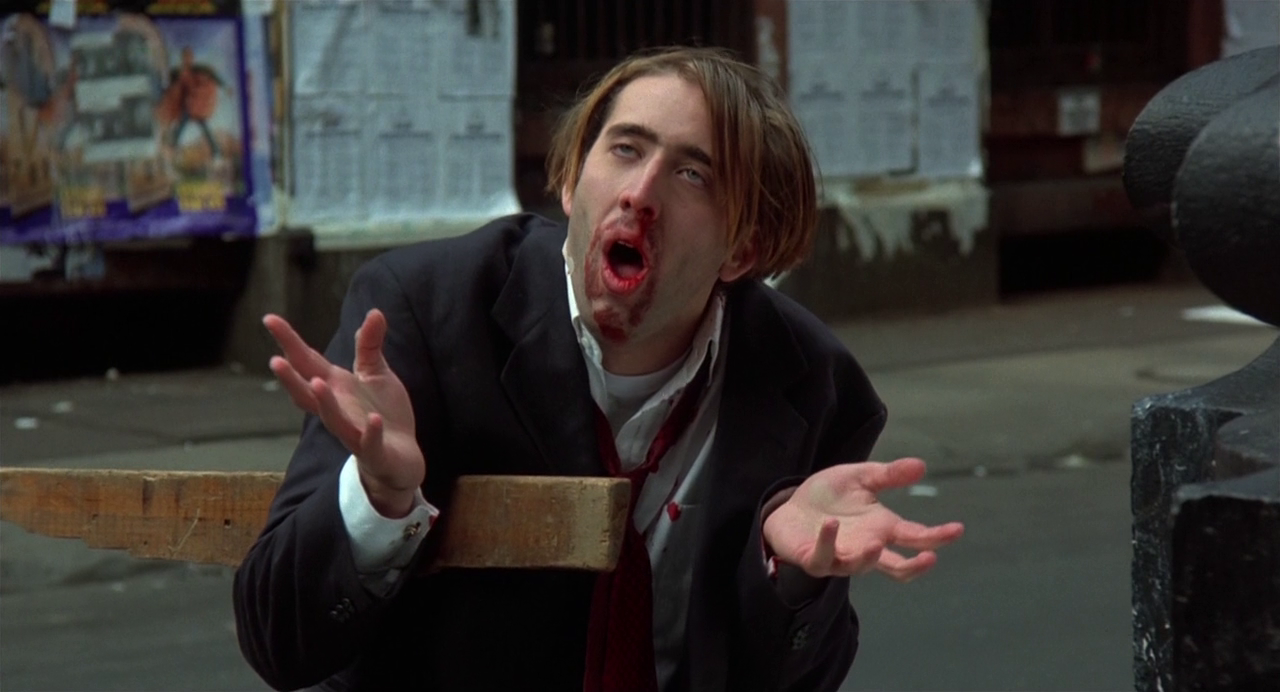
It’s not a good movie, and I knew that going in because I was vaguely familiar with the reputation that Vampire’s Kiss has. I was also vaguely familiar with it being One of Those Nic Cage movies, the ones that got him his reputation, made him a leading man for a time in the nineties and then aged him into one of the silliest DTV lead/character actor stunt castings of the last twenty years. We recently watched Renfield for this feature, which is a movie where Cage plays a vampire. This is not one of those movies. Nic Cage does not play a vampire in Vampire’s Kiss.
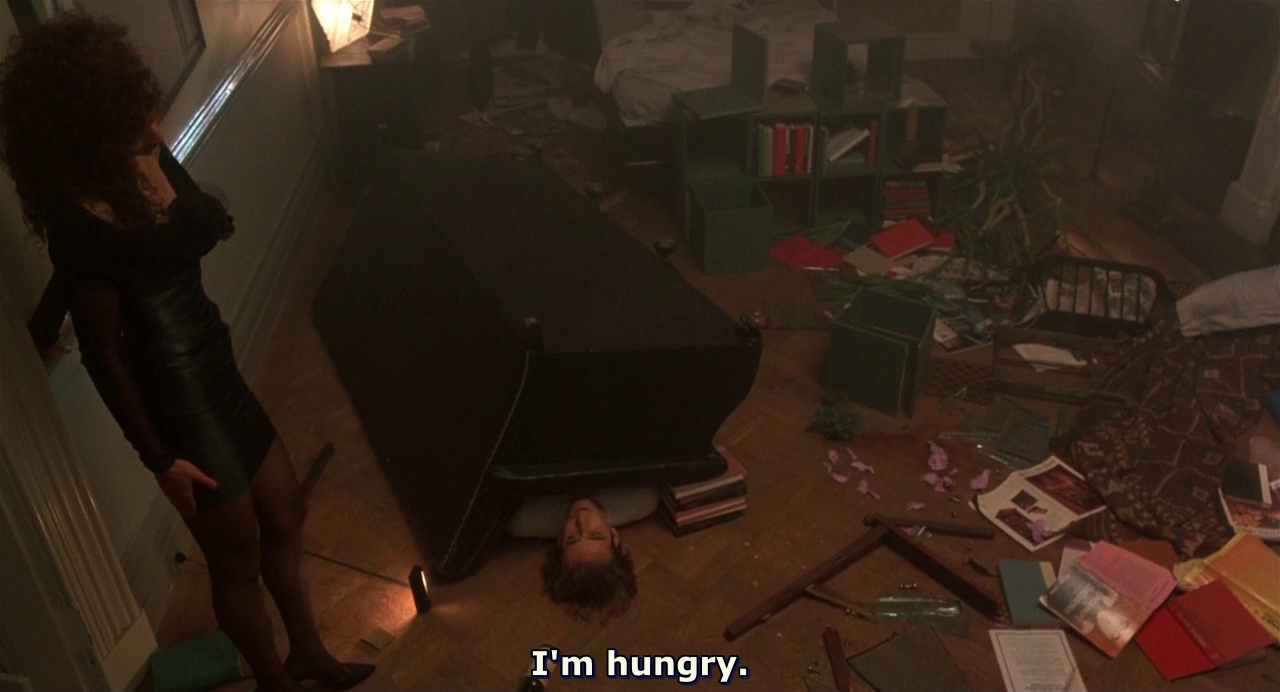
But he does play a guy who thinks he’s a vampire, and it’s one of the funnier films we've covered in this space (the Fright Nights are funnier, and much better actual movies; that might be the full list). The plot isn’t especially important; it’s basically the previous sentence stretched out over 103 minutes, with the incredibly thin fig leaf of a find-the-missing-document macguffin hunt as the inciting incident for our hero’s vile treatment of his secretary. Peter Loew (Nic Cage) is a literary agent who imagines he has hooked up with a vampire who bit him on the neck during sex. His neck is fine the next morning, but he cuts himself shaving and bandages it like a bite, after having a conversation with thin air as if the vampire was still in the apartment. At work, an important client calls looking for a document, so as part of a pre-existing campaign of sexual and regular flavor harassment against secretary Alva (Maria Conchita Alonso) he orders her to find it under penalty of losing her job. Over the course of the next few days, punctuated by unhelpful trips to therapy that also might be in his mind, Peter degenerates into a violent maniac who chases Alva around the building, to her home, and attempts to rape her. After attempting to kill himself with her handgun and failing due to it being loaded with blanks, Peter fully believes he has turned into a creature of the night. He purchases cheap fangs at a bodega and uses them to attack and murder a woman in a nightclub, before finding Rachel, the woman he based his fantasy of a vampire upon, and attempting to force her to reveal her vampire fangs to him. Ejected from the club, he wanders the dawn streets of New York fully disassociated from reality, clutching a wooden stake made from a pallet he broke apart, begging passersby to kill him and then hallucinating his therapist providing him with a wife. Back at his apartment, he breaks up with his imaginary girlfriend and crawls under a couch he’s fashioned as a coffin. Alva’s brother breaks in to avenge his sister’s abuse at Peter’s hands, and Peter offers up the stake to kill him with. The brother obliges as dawn’s rays break through the window, and Peter dies.
I know I pull the “this plot is really simple, I’ll recap it in three paragraphs” bit a lot in this space, but this one really is and I haven’t left much of anything out above. The important document simply doesn’t matter; there’s a casual girlfriend who isn’t Rachel who dumps him in the film’s first twenty minutes and isn’t seen again…and that’s about it for other characters or sub plots. The vast majority of our time here is spent with Peter, Alva, or the two of them -- there’s a more ambitious version of this script where we never (or much, much more rarely) leave Peter and correspondingly it’s much more difficult to tell what’s real and what’s in his head; the therapist, for example, probably does actually exist because he speaks with her on the phone and we get a cut to a shot of her on the other end of the line (pretty much entirely for the revelation that she’s got a hot younger man wandering around her apartment in the background and is extremely out of Peter’s league). Alva absolutely exists because she gets entire scenes without Peter in them. Some version of Rachel exists, and some form of Jackie (the other girlfriend) also probably exists. Sharon, his wife-to-be introduced in the last therapy session of the film, very obviously does not exist in any form, but she’s pretty much the only character in the whole movie of whom that’s true. There is no male character of any note in the script besides Peter; Alva’s brother is in maybe two scenes, you meet Peter’s boss once, and that’s about it. The film is otherwise entirely about Peter and how his malignant relationship with women and reality leads him to hurt them and then die in a really weird way.
Contemporary reviews of the movie pointed out how unlikeable a man Peter is as a strike against Vampire’s Kiss, with the idea that it hindered the audience from identifying or sympathizing with Peter and therefore made the events of the film less emotionally impactful. I take the opposite tack. I don’t want to identify or sympathize with this violent maniac; I want to marvel at his ridiculous, narcissistic and slapstick comedic exploits, recoil at his bizarre and confusing depredations, and then hopefully see him get what he has coming to him. And the film delivers in this regard! Cage is in full ridiculous form from beginning to end; part of the unreality of the movie comes from him being a high-powered literary agent in a depiction that even in 1988 is a bit outmoded -- in 2026, the idea of this guy being a literary agent instead of some kind of advertising executive is ludicrous. The film opens with Cage fighting with a prop bat in his apartment and closes with him assisting with his own staking, and in between there’s him jumping on desks, eating cockroaches, walking in the strangest ways possible, wearing sunglasses indoors extremely aggressively, affecting a ludicrous accent that is apparently him trying to talk like his father, Francis Ford Coppola's brother August (it sounds to the modern ear like a truly untalented comic’s attempt at Trump), buying prop fangs, seeing the price tag, and then opting to buy less expensive prop fangs, turning his couch into a coffin propped up by scavenged objects from around his house so it can sort of lift up and down like it’s hinged; there are scenes in the front half of the film of Peter being “urbane” and I assume in the script “charming” but Cage plays the guy like a zonked out space alien there too, and that works to the film’s advantage because those scenes would otherwise have nothing to recommend them.
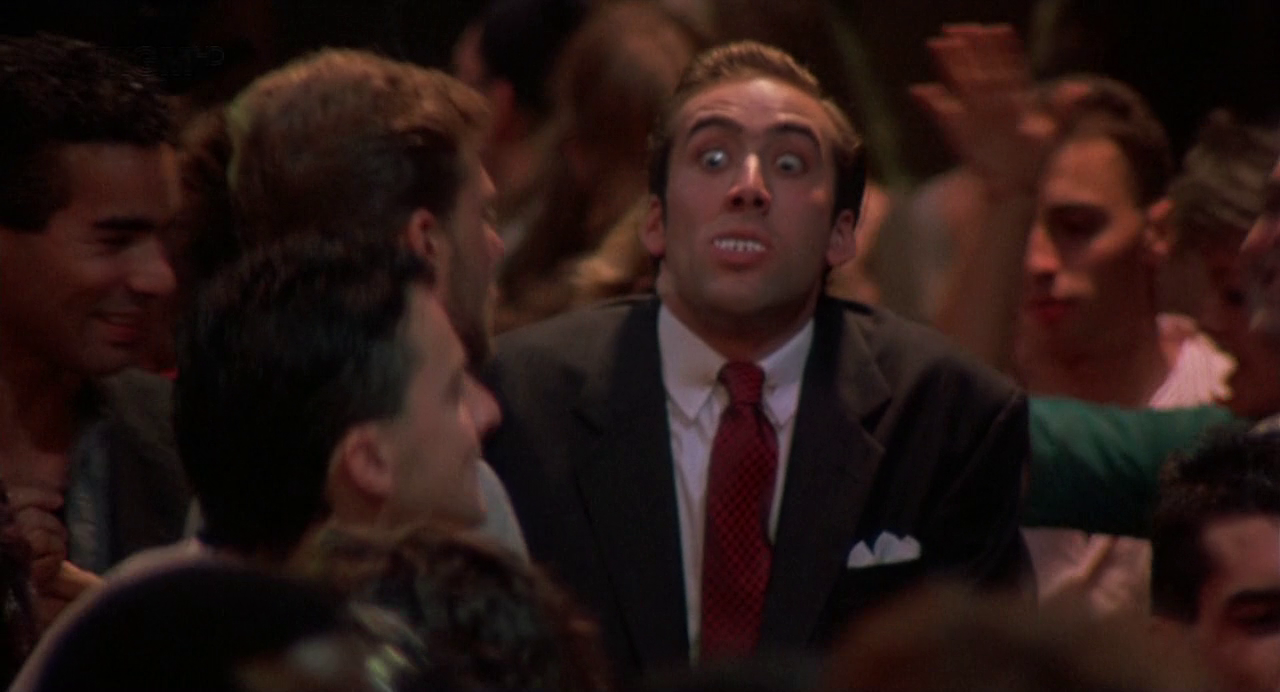
The few times the movie moves away from Peter it threatens to fall apart entirely -- the film’s brief change to Alva’s point of view as she attempts to take a sick day and Peter tracks her down at her house is especially dire, but any even brief detour away from Cage starts a ticking timer towards the viewer’s complete loss of interest. You can see why the concept, at least, would interest a guy who really fancied himself a method’s method actor and, while being an extremely weird dude who probably never would have made it on screen without his family connections, did have the magnetism to actually get the job done, no matter how bizarre the route it took to get there. This really is a movie worth watching exactly once, especially if you’re younger and are only familiar with Nic Cage’s later performances, which only get this weird when Cage wants them to. Here, in 1988, he’s firehosing the Actoring all over the production.
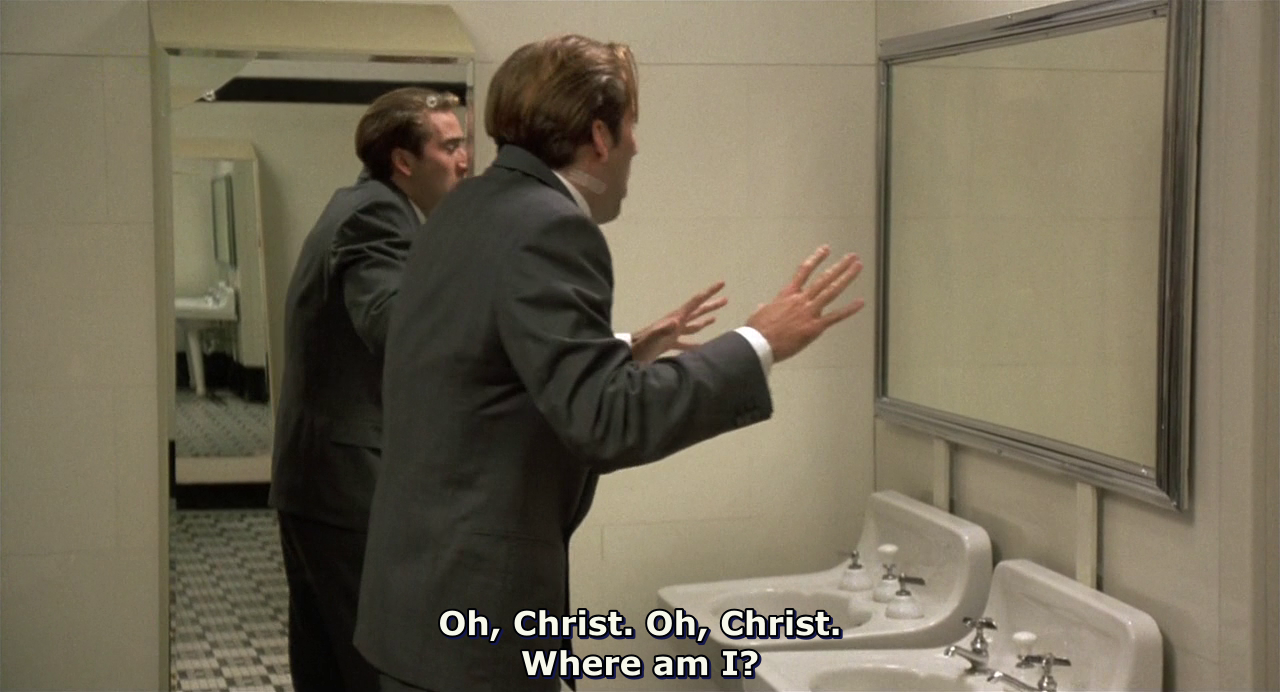
I don’t have much kind to say about the non-Nic Cage parts of Vampire’s Kiss for most of the film, but it does have the best visual gag we’ve covered so far. As the film moves into the third act and towards its violent conclusion, Peter has become completely convinced he’s a vampire, and flees into the men’s bathroom after attacking Alva at work to triumphally prove it: He looks in the mirror, and he has no reflection! This scene is shot from the side, so we cannot see the mirror over the bathroom sink that Peter is looking into from the proper angle as he cackles and shouts and demonstrates loudly; it looks empty. But there is a second mirror, of the floor-to-ceiling variety used to check your full outfit before leaving the sink, on the wall next to him. And he is fully visible in there, because of course he is; Peter Loew is completely insane. We don’t need to see the mirror he’s looking into to tell us this. In fact, we shouldn’t trust it -- nothing seen through his eyes can be trusted anymore. It’s really effective! I almost wish it was in a better movie, but then, no. I’d rather have the movie be this bad but get this performance out of Nic Cage immortalized on film than change even a single thing about it in pursuit of “improving” it. You could hammer and hammer and hammer away at this thing and finally turn it into a serious psychodrama about a guy who commits murder and rape because he thinks he’s a vampire, but in a way that tries to win Academy Awards and Say Something About Society. I wouldn’t want to watch it, though. That movie sounds like a fuckin’ drag.
Have any questions or feedback? Drop us a note in the comments below or email us at contact@goonhammer.com. Want articles like this linked in your inbox every Monday morning? Sign up for our newsletter. And don't forget that you can support us on Patreon for backer rewards like early video content, Administratum access, an ad-free experience on our website, and subscriber-only content covering competitive Warhammer 40K!