 This website uses cookies.
  Infinity N5 First Principles: Understanding Variance in Face to Face Rolls
Introduction
This is part two of an article (see part one) exploring how to think about spending your Orders in Infinity, particularly Orders where your models take Face to Face (FtF) rolls against the enemy. This is a distinctive part of Infinity’s rules. As we’ve exhaustively explained in part one, it means that, unlike in most IGOUGO wargames, the Active player can, and in the long term will, suffer losses during their own turn. Players can make good decisions, but if the dice say no, the result is not just failure to complete the action - it can be the loss of the active model. This leads to some very dramatic moments, but some players struggle with the perceived randomness of outcomes. It is common to hear players at tournaments, at all levels of skill/experience, say they would have won/lost a game if not for a given roll. This observation is technically true, but that doesn’t mean our perception of how chance impacts game results is entirely accurate.We are going to explore the level of variance one can expect in Infinity, how to deal with it psychologically, how to plan for a certain amount of variance, and generally beat the drum about not blaming your dice!
Understanding Variance
 Ever seen Achilles get killed in ARO? Photo credit: Musterkrux
In a full game of Infinity, some of the FtF rolls will go ‘against the odds’. Think back to the examples of probability we used in part one of this article. Active turn attacks, where there isn’t any particularly heavy weighting of the dice - especially high Burst/BS, or heavy penalties to the Reactive model’s ARO - will frequently have a 10-25% risk of a negative outcome. There are a lot of shooting FtF rolls in an average game. Negative outcomes will happen. This is definitely reflected in individual playstyles. Players who put apex gunfighters into their lists, or use tools like smoke-shooting, to set up Orders with very low negative outcome chances, will experience fewer moments where their gameplan falls apart to a 'lucky' ARO. That's not to say players shouldn't take reasonably risky fights to save Orders and try to build an advantage. But we should all be realistic about it - if you are taking repeated, reasonably-advantageous fights throughout a game, you need to plan for some of them to go against you.
Even harder for our monkey brains to accept is that freakish, unthinkable minority outcomes will happen. We mentioned a 1% chance earlier, of a TAG taking damage while trying to shoot a heavily disadvantaged light infantry model. That has happened to your author, from both sides. Whenever some extremely unlikely roll occurs, it is always tempting to fall back on cursing your luck, or categorising the consequences under “well that shouldn’t have happened”. Kill this instinct if you can. It can happen, sometimes it does, part of playing the game is dealing with it. A 5% outcome is really not that unlikely, when a close fought game probably has ~30-50 FtF rolls, many of which contribute meaningfully to the final result. 1% outcomes should also crop up every couple of games.
There’s an old gamblers’ expression ‘the cards have no memory’ and this applies equally to dice. Experiencing 5 negative outcomes in a row does not affect the odds of the 6th attempt. I also like to remind myself that the dice have no awareness - certainly they don’t understand how to play Infinity. It is completely random whether minority outcomes and freak rolls happen in the most crucial Orders of the game, or during irrelevant side-shows.
Dealing with Tilt
A major part of why we mention variance here is that it is a major source of player ‘tilt’. For anyone unfamiliar with this term, this is the loss of psychological balance brought on by the pressure of repeated negative outcomes, perceived ‘bad luck’, or just being unable to bring about your desired result during a game. It is all too easy, on experiencing extremely unlikely negative outcomes, to tilt and take your next action without thinking, frequently to reinforce failure or chase the same positive outcome that didn’t appear before, e.g. attacking the model that just killed yours in ARO. This is, at least partly, borne of our hindbrains’ approach to chance. We think that because the first roll didn’t work, if we roll again, we must get lucky sooner or later. Try and remind yourself that this is not true. Take a breath and analyse things afresh after every negative outcome, and put ‘luck’ out of your mind.Beyond avoiding tilt, there are very good reasons to stop and think after a negative outcome in the Active Turn. Loss of a key piece could mean your plan for the rest of the Turn, or the whole game, is no longer sound. What other phases of your plan were dependent on that model? What is your next best option? How has the loss changed the situation? These are all important questions to ask, and it can be very difficult to focus on them past the fog of “I can’t believe that just happened”.
Optimism Bias
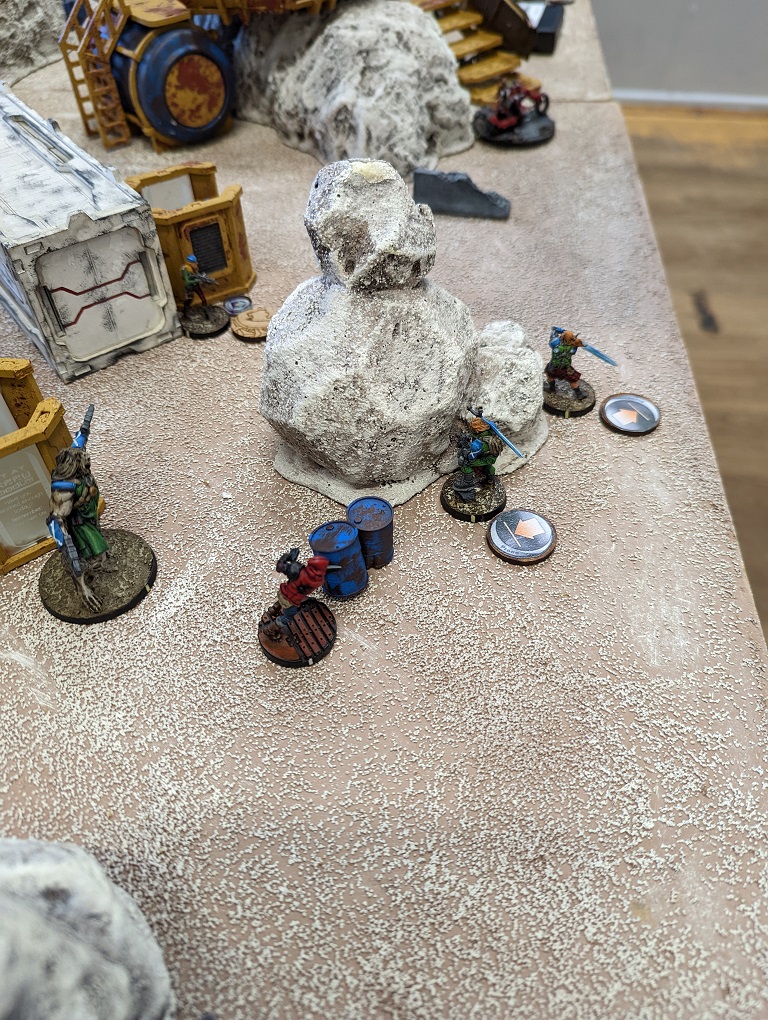 An infiltrating Bandit launches an attack on multiple enemy models. He will slay them all and emerge triumphant, right? Right?
We've already alluded to players’ assumption that their plan will work out. It's easy to understand that this isn't true; it's harder to plan effectively for failure. We’ve mentioned the dangers of risk aversion already. The best rule of thumb to keep your plans realistic is to allow extra Orders. You can't worry about the risk of extremely unlikely negative results too much when crafting a plan for your Turn or the overall game. If they happen, they happen and you can make a new plan. What you should always plan for is null outcomes, which will be more likely than negative outcomes if you are playing your Active Turns at all well. The way to do this is by allowing extra Orders.
It's very tempting, and completely natural, when you have 8 Orders in a group, to envision your Turn as 8 separate, successful actions and then try to execute that plan. But such plans are highly prone to failure. Your optimism bias is leading you to expect 100% success from interactions that are probably, if they are well thought out, individually 60-90% likely to be positive. Clearly, if your 8 Orders involve say 5 FtF rolls, the chance of a positive outcome on all 5 is small. Players should make plans, wherever possible, which leave 1-3 Orders ‘unused’. In reality, those Orders will be for reattempting crucial rolls that have gone awry.
Hinge Points
As alluded to when talking about extremely unlikely outcomes earlier, there are certain hinge points in every game where it is obvious the outcome makes a huge difference. Examples would be a deadly FtF roll between apex gunfighters, or a chance to activate an Objective with the last Order of the game. While these are crucial moments (and a great source of excitement and enjoyment), thinking clearly about variance and the role of the dice means bearing in mind why they are hinge points. It’s technically correct to say ‘I would have won the game if I’d made that last WIP roll’. But that won’t make you a better player. Almost every hinge point in a game is the result of other branching decisions which led to those circumstances. It is more insightful to say ‘I could have had spare Orders to re-attempt that WIP roll if I had taken these decisions earlier in the game’. Try to look beyond the most obvious randomness of the outcomes, and examine how you could have altered the odds before rolling, whether your decisions were based on a sound understanding of the risks, and whether you had any other plays available.Confirmation Bias
I have been told, by all manner of players, including some who are objectively better than I am, some variation of "my luck is terrible". Some of these remarks have hit achingly close to the truth by saying "I don't rely on [FtF rolls/WIP rolls/survival rolls] because my luck is terrible". In case my position here wasn't obvious, in the long term no one has luck, good or bad. What they have is confirmation bias. The most obvious manifestation is that players remember unlikely or extremely unlikely outcomes against them very clearly; they identify them as hinge points and attribute them to 'bad luck'. Most people give far less weight to similar outcomes in their favour. This overlaps with the psychology of optimism bias and our expectations of success. When we try an Order, which requires dice rolling, and succeed, our plan has worked as intended - this is the right and proper thing to happen. If the dice say we fail, that is an aberration.We mentioned that 1% outcomes will crop up every couple of games. People tend to remember these when they befell an important model or occurred at an identifiable hinge point. If your SMG-toting support trooper kills a TAG in ARO, you’re going to tell everyone about it. A heavily favoured active turn gunfighter rolling 3 crits at once and dealing 5+ wounds to a cheap target is every bit as mathematically unlikely, but no one cares - it doesn’t make any material difference compared to the more likely outcomes.
Why is this thinking a problem? It clouds players' perception of the odds and hampers them from learning the difference between good and bad risks. Few of us are really playing enough games to smooth out 'luck' and provide a sufficient sample size to draw real conclusions about what works and what doesn't from experience alone. We need the context of understanding the chances behind the dice results.
 Credit: Musterkrux
Conclusion - Planning for Variance
The advice given in conclusion of the first part of this article was basically about planning to get the best odds possible on your rolls (balanced against Order pressure) and considering the possible impact of those rolls when deciding how much risk is acceptable. Having looked at the often-misunderstood role of variance in Infinity, our advice now echoes some of the same points, with more of a stress on dealing with the unexpected.Most important is the need to think analytically and clearly about chance. Don't ever expect luck to save you; play the odds with your eyes open and accept that sometimes you will win and sometimes you will lose. Learning should be constant, but try and analyse whether the odds of your plan succeeding were good - don't be overly influenced by whether it succeeded or failed in the dice tray. Unless you are playing games multiple times per week, your sample size is too small to learn lessons about Infinity odds purely from experience. You will need to do some maths to check your instinctive understanding.
Beyond just playing the odds, we would urge players to suppress their instinct to plan only for success. In attack, this would be having X Orders, and planning to take X-1 FtF rolls, so that if you win all of them, you can have 1 roll to activate the Objective! Even when taking favoured FtF rolls, you are going to get some null outcomes and need more Orders to batter through. In many cases, you will get a significant negative outcome [i.e. lose your Active model] and you should ideally have a contingency plan for this. In defence, planning for success would be setting up an ARO piece and simply hoping it will defeat any enemy attackers. Better to ask yourself how many Orders the enemy must spend to take a realistic FtF roll against it; if your ARO piece disappears on the first FtF roll, what other layers of defence do you have?
No one can plan entirely for repeated, unlikely negative outcomes in a game. Everyone will lose games sometimes and conclude there was nothing different they could have done; the dice simply said no. What we urge is for players to stave off that initial, emotive reaction “I was unlucky”. Whether you lose or win, play back your plan, and your opponent’s if you understand it, and see where decisions were playing the odds correctly. Don’t reject games as some sort of unholy mistake in god’s creation if they involved hinge points where minority outcomes occurred. These are part of normal play. Instead, ask if there were any plans available that didn’t expose you to that low-probability, high-impact risk. Ask if there were any ways for the losing player to recover from that outcome. If you think you are losing a lot of games because you are unlucky, you are wrong - you are losing because you are taking bad risks, or not allowing enough Orders to make success reliable.
Get out there and play some games. We won't wish you good luck, but rather say we hope you will calculate your odds accurately!
Have any questions or feedback? Drop us a note in the comments below or email us at contact@tabletopbattles.com. Want articles like this linked in your inbox every Monday morning? Sign up for our newsletter. And don't forget that you can support us on Patreon for backer rewards like early video content, Administratum access, an ad-free experience on our website, and subscriber-only content covering competitive Warhammer 40K!